

CHD Vann project revived: after a decade-long wait marked by uncertainty, halted construction, and anxious homebuyers, one of Gurugram’s most talked-about residential addresses is finally getting a second lease of life.The story of project revived CHD Vann is not just about bricks, mortar, and possession letters. It is about restored trust, judicial intervention, and a landowner stepping up to fix what a builder could not finish. For the hundreds of families who booked their homes years ago on apartments in Sohna Road Gurgaon for sale, this revival is nothing short of a homecoming that was almost lost.We walk through the entire journey of CHD Vann, from its ambitious launch in 2014, through the long stall during the insolvency of CHD Developers, all the way to the National Company Law Tribunal (NCLT) order that has now handed the project to Roots Developers, the landowner. Along the way, we look at what buyers can expect next, and why this revival matters for the larger Gurugram real estate story.
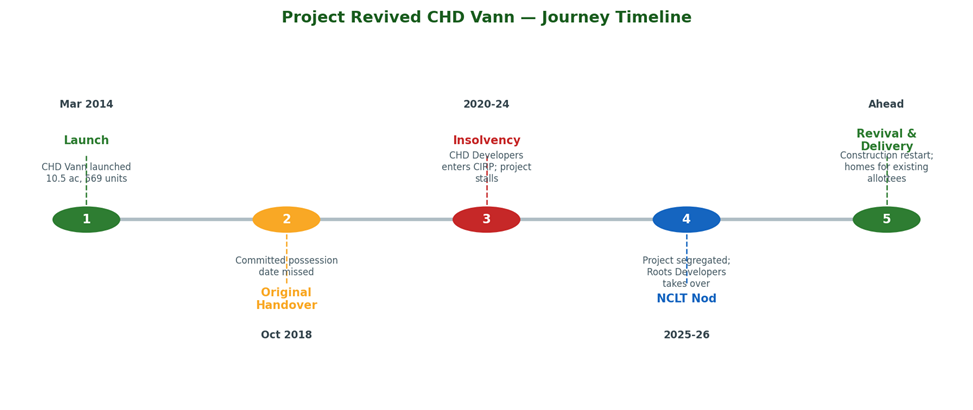
Figure 1: The CHD Vann journey — from 2014 launch to the current landowner-led revival.
The Original Launch: A Forest in the City
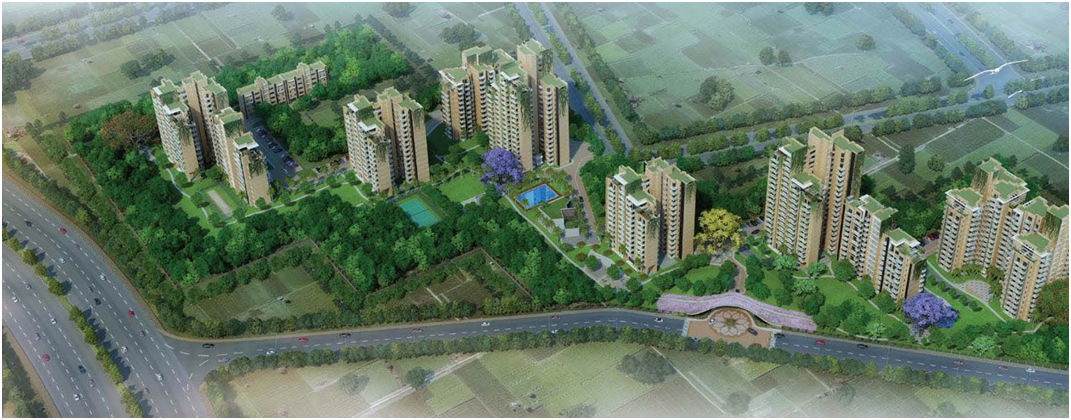
CHD Vann was launched in March 2014 by CHD Developers Ltd, a name that was, at the time, riding on decent visibility in the Delhi NCR market. The project was positioned as a premium, low-density, green-first residential community in Sector 71, along the fast-emerging Sohna Road corridor. Spread across roughly 10.5 acres, the plan featured around 12 towers with approximately 569 apartments in two, three, and four BHK configurations.
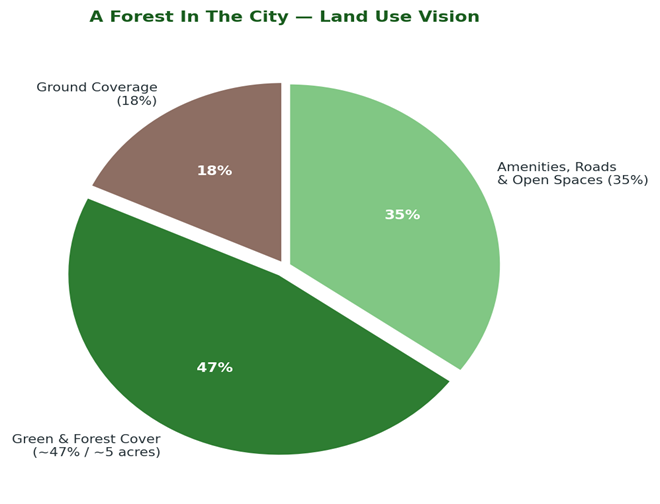
The tagline sold to buyers was compelling. Vann, meaning forest, promised a wooded, forest-like ambience within the city. Marketing collateral proudly highlighted that ground coverage would be kept at just about 18 percent, with the remaining land dedicated to landscaping, tree cover, walking trails, and open breathing spaces. Roughly 5 acres of the total layout were earmarked as green cover, a rare offering in the increasingly dense Sohna Road belt.
Unit sizes ranged from around 1,058 sq. ft. to 2,924 sq. ft., and the amenities list was aspirational for its time. Residents were promised a full-scale clubhouse with a swimming pool, gymnasium, and bistro, along with a yoga deck, jogging trails, sports courts, kids’ play areas, an on-site nursery school, and a small retail zone for daily convenience. The original committed possession was October 2018.
Quick Facts — Project Revived CHD Vann
| Attribute | Details |
| Project | CHD Vann |
| Location | Sector 71, Sohna Road, Gurugram |
| Original Developer | CHD Developers Ltd |
| Launched | March 2014 |
| Land Parcel | ~10.5 acres |
| Towers / Units | ~12 Towers, ~569 Units |
| Configurations | 2 / 3 / 4 BHK apartments |
| Unit Sizes | 1,058 sq. ft. – 2,924 sq. ft. |
| Ground Coverage | ~18% (rest dedicated to greens) |
| Green Cover | ~5 acres of forest-like landscape |
| Original Possession | October 2018 (missed) |
| Reason for Stall | CHD Developers CIRP / Insolvency |
| Revived By | Roots Developers Pvt. Ltd (Landowner) |
| Legal Basis | NCLT segregation order |
| Settlement with Edelweiss ARC | Approx. INR 22.9 crore |
Figure 2: The forest-in-the-city vision — only 18% ground coverage, with the balance dedicated to greens and open spaces.
When the Dream Went Silent: The Long Stall
Then, sometime after 2017, the momentum began to fade. Construction slowed, milestones were missed, and calls to the developer’s office started returning fewer answers than questions. What was meant to be a 2018 handover slipped into 2019, then 2020, and eventually into a full stall.
The reason was the financial collapse of the parent developer. CHD Developers Ltd was dragged into the Corporate Insolvency Resolution Process (CIRP) under the Insolvency and Bankruptcy Code. Once a developer enters CIRP, all of its assets and projects come under the control of a Resolution Professional, and normal construction activity typically freezes. Approvals, receivables, land rights, and licenses all get tangled in the insolvency web.
For CHD Vann, this meant a decade-long limbo. Homebuyers who had paid 80, 90, sometimes even 95 percent of the flat cost were left staring at half-built towers. Some continued to pay EMIs on loans for homes that did not yet exist. Others took the emotional and financial hit of buying or renting elsewhere while still holding on to hope. Buyer associations formed, complaints piled up with RERA and consumer forums, and social media became the unofficial noticeboard for updates.
Enter Roots Developers: The Landowner Steps Forward
The turning point arrived in the form of the landowner. Roots Developers Pvt. Ltd, which held the underlying land rights for the CHD Vann project, decided to step forward and take responsibility for delivery. This is a key nuance many casual observers miss. Roots was not a random buyer or opportunistic investor. As the landowner, it already had a legal and commercial interest in the asset. When CHD’s insolvency threatened to sink the project entirely, Roots chose to be the party that saved it rather than watch its own land value collapse along with buyer sentiment.
To free CHD Vann from the wider CHD Developers insolvency case, the project needed to be legally segregated. That required approaching the NCLT, negotiating with lenders, and structuring a settlement that would clear existing financial claims on the project. Edelweiss Asset Reconstruction Company (ARC) held a significant claim tied to the CHD Developers debt, and any credible revival plan had to address that first.
Roots Developers negotiated a settlement to clear those claims. In exchange, Roots gains full, unencumbered rights over the CHD Vann project — the land, licenses, approvals, and receivables from existing buyers — free from the past insolvency baggage of CHD Developers.
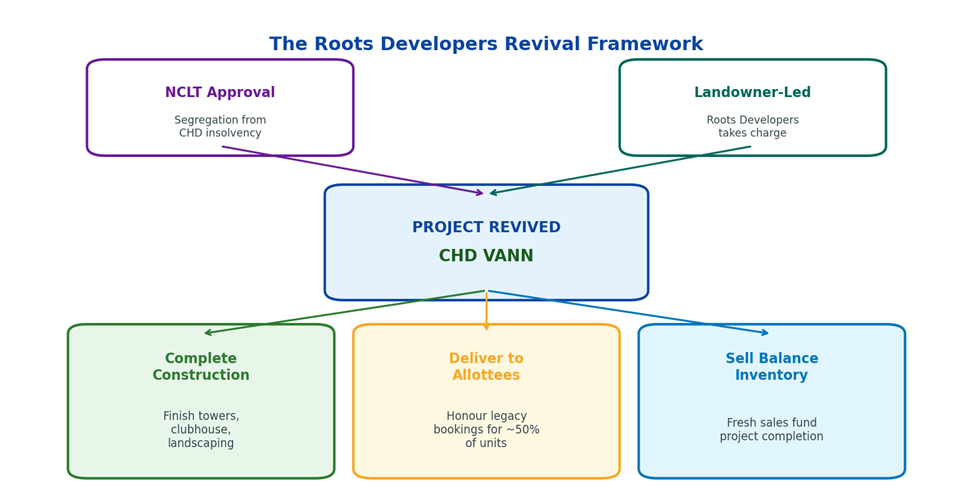
Figure 3: The Roots Developers revival framework — NCLT approval and landowner accountability feed into three concrete delivery pillars.
The NCLT Nod: Legal Green Light for Revival
The turning point came when the NCLT approved the segregation of the CHD Vann project from the CIRP of CHD Developers Ltd. This ruling is the legal cornerstone of the entire revival story. Without it, no bank would fund, no contractor would sign, and no serious buyer would trust a fresh timeline.
By segregating Vann, the tribunal effectively drew a boundary around the project and said, in essence, this asset can now move forward on its own track, under a new custodian, with clean rights. The order gives Roots Developers exclusive responsibility for executing and delivering CHD Vann, without being dragged back into every twist of the parent developer’s insolvency proceedings.
Before vs After — What Actually Changes
The revival is not just a change of name plates. It is a structural reset that changes the legal, financial, and delivery footing of the project. The table below distils the key shifts.
| Aspect | Before (Stalled Era) | After (Revival Era) |
| Custodian | CHD Developers Ltd (in CIRP) | Roots Developers Pvt. Ltd (Landowner-led) |
| Legal Status | Locked inside insolvency proceedings | Segregated via NCLT order |
| Land, Licenses & Approvals | Encumbered by parent company debt | Clean rights consolidated with Roots |
| Homebuyer Confidence | Low, prolonged uncertainty | Restored through structured plan |
| Construction | Halted for years | Restart planned, tower by tower |
| Delivery Roadmap | Undefined | Complete → Deliver → Sell balance |
What the Revival Plan Looks Like
Roots Developers has been fairly transparent about its intent. The plan for the revived project rests on three pillars. First, complete the construction of the pending towers and finish the common infrastructure, clubhouse, landscaping, and utilities as originally envisioned. The forest-in-the-city vision, with generous green cover and low ground coverage, remains central to the pitch.
Second, deliver homes to existing allottees. Roughly half of the 569 units are already booked by legacy buyers who have been waiting for years. Their bookings, payments, and rights are being honoured under the new structure. Any revival that alienates existing buyers is destined to hit fresh legal walls, so this pillar is non-negotiable.
Third, sell the remaining inventory at current market rates to fund the completion. This is standard practice in stalled-project revivals. The unsold flats effectively become the working capital of the revival. Given that Sohna Road prices have appreciated meaningfully since 2014, the fresh sales are expected to generate the runway needed to finish the project without new external debt of a burdensome kind.
Why This Matters for Sohna Road and Gurugram
The revival of CHD Vann carries symbolic weight well beyond the boundaries of Sector 71. Sohna Road and the Southern Peripheral Road belt have seen a wave of new launches, elevated corridor progress, and infrastructure upgrades in recent years. But investor and end-user confidence in this stretch was partly bruised by the memory of stalled projects from the previous cycle.
Every time a long-stuck project like Vann restarts under credible hands, it sends a signal. It tells buyers that legal frameworks like the IBC and NCLT process, while slow, can eventually deliver outcomes. It tells lenders that landowner-led revivals with clean settlement structures can be viable. And it tells the broader market that Gurugram’s stalled inventory is not necessarily lost inventory.
Location-wise, Sector 71 is now in a very different position than it was in 2014. The Sohna Elevated Corridor has transformed connectivity between Gurugram and Sohna, cutting travel times sharply. The Golf Course Extension Road, IMT Manesar, Cyber Hub, and IGI Airport are all within a comfortable driving radius. Schools such as GD Goenka and Pathways, hospitals like Medanta, and multiple retail hubs have matured in the neighbourhood. A well-executed low-density project in this micro-market today is, arguably, more valuable than it would have been at original launch.
What Existing Buyers Should Watch For
For legacy allottees, the NCLT order is a relief, but the practical journey is only starting. A few things are worth tracking closely in the coming quarters. The revised construction timeline and possession schedule will be the first big communication from Roots Developers. Buyers should look for clarity on which towers get completed first, how snagging and fit-outs will be handled, and what the handover protocol looks like.
Buyers should also expect fresh documentation. A revived project under a new custodian typically involves updated agreements, revised RERA filings, and clean title certifications. Keeping copies of original booking documents, payment receipts, and communication history remains important. So does staying engaged with the buyer association, which has been a critical voice throughout the stall.
For fence-sitters looking at the fresh inventory, the story is different. They walk into a project that now has clean legal footing, a defined revival plan, an experienced landowner in charge, and a location that has matured significantly since the original launch.
The Bigger Lesson: Landowner Accountability
There is a quieter, deeper lesson embedded in the CHD Vann revival. Traditionally, in joint development or licence-based housing projects, landowners have often been treated as passive parties. When developers fail, landowners typically wait on the sidelines, hoping insolvency courts and creditors sort things out.
Roots Developers has flipped that script by choosing to be the active revival party. It is one of the few landowners in the NCR to have proactively stepped into the delivery seat, negotiated with lenders, and taken on the operational risk of finishing a stalled tower community. If more landowners across NCR’s stuck projects adopt a similar posture, thousands of homebuyers could see faster, cleaner resolutions.
Frequently Asked Questions
Q. When was CHD Vann originally launched?
A. CHD Vann was launched in March 2014 by CHD Developers Ltd on Sohna Road, Sector 71, Gurugram, with a committed possession date of October 2018.
Q. Why did the project get stalled?
A. The project stalled because the parent developer, CHD Developers Ltd, entered Corporate Insolvency Resolution Process (CIRP). Once a developer is in CIRP, its assets, licenses, and receivables are frozen under a Resolution Professional, and construction typically stops.
Q. Who is reviving CHD Vann now?
A. Roots Developers Pvt. Ltd, the landowner for the CHD Vann project, is reviving it. Roots has taken exclusive responsibility for completing construction and delivering homes to existing allottees.
Q. What role did the NCLT play in the revival?
A. The National Company Law Tribunal approved the segregation of CHD Vann from the wider CHD Developers CIRP. This is the legal foundation of the revival because it separates the project’s land, licenses, approvals, and receivables from the parent company’s insolvency proceedings.
Q. What is the settlement amount with Edelweiss ARC?
A. Roots Developers has agreed to pay approximately INR 22.9 crore to Edelweiss Asset Reconstruction Company to clear outstanding claims tied to the CHD Developers debt, in exchange for clean rights over the project.
Q. What happens to existing homebuyers who booked years ago?
A. Existing allottees’ bookings, payments, and rights are being honoured under the revived structure. Roots plans to complete construction and hand over homes to them first, before releasing further fresh inventory.
Q. Will the original design and green cover be retained?
A. Yes, the forest-in-the-city vision — approximately 18% ground coverage with the remaining land as green cover, landscaping, walking trails, and open spaces — remains the design anchor of the revived project.
Q. How will Roots Developers fund the completion?
A. Funding for completion is largely planned through the sale of unsold inventory at current Sohna Road market rates. Since prices have appreciated meaningfully since 2014, fresh sales are expected to generate the runway needed to complete construction.
Q. Is CHD Vann a good buy now?
A. For fresh buyers, CHD Vann now offers clean legal footing, a landowner-led revival, and a location that has matured with the Sohna Elevated Corridor, Golf Course Extension Road, and improved social infrastructure. As with any real estate decision, buyers should verify current RERA filings, revised timelines, and updated agreements before committing.
Q. How is CHD Vann connected to key parts of Gurugram?
A. Sector 71 sits on the Southern Peripheral Road belt. Residents have easy access to Golf Course Extension Road, Cyber Hub, IMT Manesar, and IGI Airport, with the Sohna Elevated Corridor further improving travel times to and from Sohna.
Looking Ahead
The phrase project revived CHD Vann is now more than a headline—it is a working blueprint for how stalled residential developments can make a successful comeback. A 2014 launch that once seemed destined to become another cautionary tale of Gurugram’s boom-era excesses has instead evolved into a case study in structured revival. From its original vision of a forest-inspired community on Sohna Road, through years of insolvency and buyer uncertainty, to the landmark NCLT order and the Roots Developers takeover, the project has finally turned toward delivery. For homebuyers and investors exploring the best property investment in Gurgaon 2026, the revival of CHD Vann highlights how legally revived projects in prime locations can present strong long-term value, improved buyer confidence, and renewed investment opportunities.
For Sector 71, this is good news. For homebuyers who kept faith, it is overdue relief. And for the broader Gurugram real estate market, it is a reminder that even the most tangled projects can find their way home when the right hands take charge. The next chapter of CHD Vann is being written not by promises, but by construction schedules, handover milestones, and the everyday sound of families finally moving in.