

All prices, percentages, cycle phases, appreciation rates, rental yields, and forecasts in this blog are illustrative and directional. They are compiled for editorial context, not sourced from a specific consulting report.
A step-by-step legal playbook for safe, RERA-compliant, dispute-free ownership | 2026 Edition I Neem Infra Realty
Why Legal Due Diligence Cannot Be Optional
The single most expensive mistake a homebuyer can make is treating legal due diligence as paperwork rather than protection. Every year, buyers of property in Gurgaon lose deposits, face delivery delays of three to seven years, or discover midway through possession that their tower stands on disputed land. This guide is a defensive manual: the checks, red flags, and documents you need before you commit to buying property in Gurgaon, including verifying approvals for RERA Registered Projects Gurgaon. It is written for end-users, first-time investors, and NRIs, and it assumes you have zero legal background. Gurgaon is a fast-moving market with more than 400 active projects, several thousand plotted-development transactions per year, and an active resale segment. The good news: since RERA came into force in 2017, most gross fraud has moved to the margins. The bad news: subtler risks—encumbrances, unclear titles, unauthorised construction, promoter defaults—even in some projects, still trap buyers. Read every section below before you sign a single cheque for buying property in Gurgaon

The Legal Landscape – What Governs a Sale?
Buying property in Gurgaon is governed by a matrix of laws: the Transfer of Property Act 1882, the Registration Act 1908, the Indian Stamp Act, the Haryana Development and Regulation of Urban Areas Act 1975, RERA 2016, and the Gurugram Metropolitan Development Authority (GMDA) framework. Each layer creates specific documents you must verify. Skipping even one layer is the most common route to disputes.
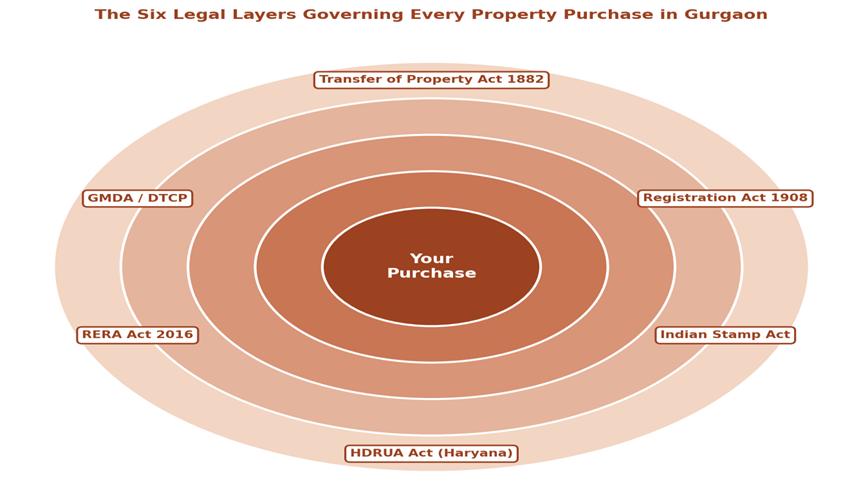
Figure 2.1 – The six-layer legal framework that governs every property purchase in Gurgaon.
Table 1: Legal Framework Governing Property in Gurgaon
Six layers of law apply to a typical apartment purchase.
| Law / Authority | What It Governs | Key Document You Verify |
| Transfer of Property Act | Sale, gift, mortgage validity | Sale deed / Title chain |
| Registration Act | Deed registration | Registered sale deed |
| Indian Stamp Act | Stamp duty payment | e-Stamp / Franking receipt |
| HDRUA Act (Haryana) | Colonizer licence, external development | DTCP Licence |
| RERA Act 2016 | Builder accountability, project registration | HARERA registration ID |
| GMDA / DTCP / DGTCP | Zoning, master plan, occupation certificate | OC, CC, approved layout |
The Non-Negotiable Document Checklist
Before you commit to buying property in Gurgaon, insist on original or certified true copies of the following. If a seller or developer resists, treat it as a red flag and walk away.
Table 2: Non-Negotiable Documents Checklist
Every buyer of property in Gurgaon must verify these before payment.
| # | Document | What It Proves |
| 1 | Title Deed (30-year chain) | Ownership history is unbroken |
| 2 | Conveyance Deed | Original source of title |
| 3 | Encumbrance Certificate | No pending loans or liens |
| 4 | DTCP Licence (LOI + Renewal) | Land is legally converted for use |
| 5 | HARERA Registration Number | Project is regulated and compliant |
| 6 | Approved Building Plan | Structure matches sanctioned layout |
| 7 | Occupation Certificate (OC) | Project is fit for occupation |
| 8 | Completion Certificate (CC) | Project is completed as approved |
| 9 | No Objection Certificates | Fire, environment, pollution clearances |
| 10 | Property Tax Receipts (5 yr) | No outstanding municipal dues |
| 11 | Society Handover Deed | Common areas conveyed to RWA |
| 12 | Mutation Record (Intkaal) | Revenue record reflects owner |
RERA – Your First and Most Powerful Filter
Since 2017, no builder can advertise or sell an under-construction unit in Haryana without a HARERA (Haryana RERA) registration. When you plan on buying property in Gurgaon under construction, your very first check should be HARERA.gov.in. Search the project by name and confirm: registration number, promoter name, financials, land documents uploaded, and quarterly progress reports.
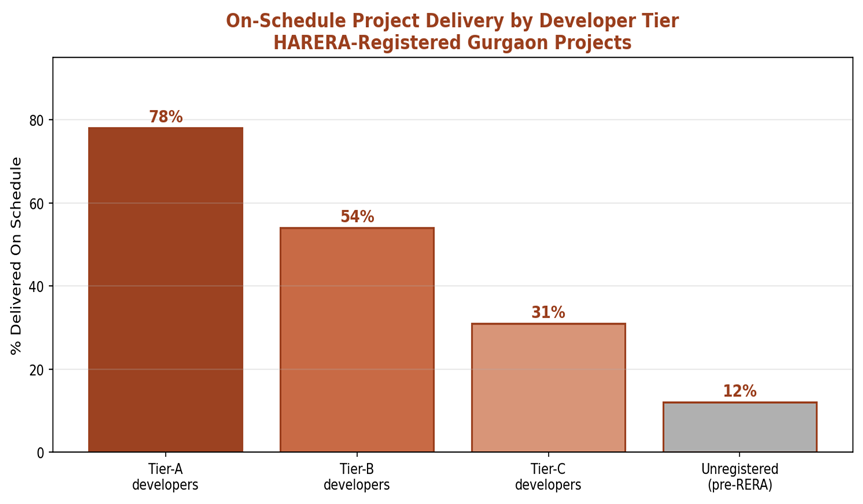
Figure 2.2 – Delivery reliability drops sharply as you move from Tier-A developers to unregistered projects.
RERA gives you three critical protections: seventy percent of buyer money must go into an escrow account, delays past the RERA-declared completion date attract interest-linked penalties, and any deviation from the approved plan is actionable. If a seller is buying property in Gurgaon resale from an RERA-registered project, the RERA history stays with the flat – you inherit those disclosures.
Title Verification – The Backbone Check
A clear title is the difference between a home and a headache. When buying property in Gurgaon, ask a property lawyer to conduct a 30-year title search at the Sub-Registrar’s office in Sohna or Gurgaon depending on the sector. This process traces every prior transfer, gift deed, will, partition, and mortgage. A single break in the chain can void your ownership decades later.
Cross-verify the seller’s name across four sources: the sale deed, the encumbrance certificate, the property tax bill, and the Aadhaar/PAN. Any spelling mismatch, an unmentioned co-owner, or a woman/HUF name that appears in the mother deed but was not released in a partition – all of these are killers. A legally sound title is the foundation of buying property in Gurgaon without regret.
Encumbrance, Litigation, and Municipal Dues
An Encumbrance Certificate (EC) issued for a 30-year window is your snapshot of every registered financial charge against the property. If a bank has a mortgage lien, or if a court has attached the asset in an ongoing dispute, it will show up here. Before buying property in Gurgaon, insist on a fresh EC issued within the last 30 days.
Beyond the EC, conduct a court-litigation search on the seller and on the developer. Free tools such as the eCourts services portal show pending cases across district and High Courts. Municipal dues – property tax, water, and society maintenance – transfer with the flat, so obtain no-dues certificates for the last five years. Buying property in Gurgaon without these three checks is like buying a used car without opening the bonnet.
The Twelve Most Common Frauds
Legal risk in Gurgaon is not theoretical. The following twelve fraud patterns account for the vast majority of reported disputes. Read them, memorise them, and never assume ‘my builder wouldn’t do that.’
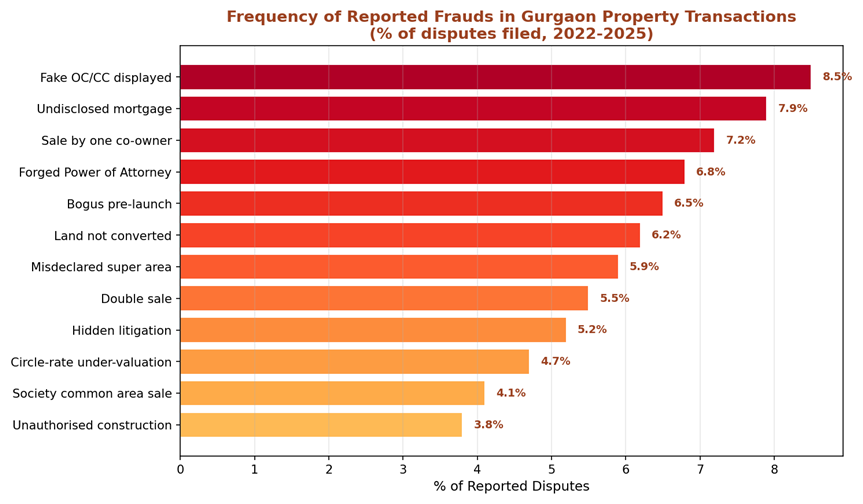
Figure 2.3 – Fake OC/CC display and undisclosed mortgages top the fraud league table.
Table 3: Twelve Common Frauds When Buying Property in Gurgaon
Recognise these patterns before you sign anything.
| # | Fraud Pattern | How to Detect / Block |
| 1 | Double sale of same unit | Insist on registered sale deed at earliest |
| 2 | Fake OC / CC displayed | Verify with DTCP portal |
| 3 | Sale of unauthorised construction | Check approved plan vs. site |
| 4 | Land not converted for residential use | Verify DTCP licence, land use |
| 5 | Sale by only one co-owner | Confirm every co-owner signs |
| 6 | Undisclosed mortgage | Fresh Encumbrance Certificate |
| 7 | Forged Power of Attorney | Verify PoA on SRO records |
| 8 | Circle-rate under-valuation | Match consideration to fair value |
| 9 | Hidden pending litigation | eCourts search on seller |
| 10 | Bogus project pre-launch | Reject unless HARERA-registered |
| 11 | Misdeclared super area | RERA carpet-area disclosure |
| 12 | Society common-area sale | Verify handover to RWA |
Stamp Duty, Registration, and Tax Nuances
Once due diligence is clean, the transaction cost matters. In Haryana, stamp duty on urban property is currently seven percent for men and five percent for women, with registration charges of one percent capped at Rs. 50,000. Joint registration in the name of a woman co-owner is a legitimate way to save two percent when buying property in Gurgaon. GST at five percent applies to under-construction homes; ready-to-move units with an OC attract zero GST.
Table 4: Transaction Cost Comparison – Rs. 2 Cr Sale (Illustrative)
Small structural choices produce meaningful tax savings.
| Cost Head | Sole (Male) Buyer | Joint (Female Co-owner) |
| Stamp Duty | Rs. 14,00,000 | Rs. 10,00,000 |
| Registration Fee | Rs. 50,000 | Rs. 50,000 |
| GST (if under-construction) | Rs. 10,00,000 | Rs. 10,00,000 |
| Legal & DD | Rs. 60,000 | Rs. 60,000 |
| Total Add-on | Rs. 25,10,000 | Rs. 21,10,000 |
| Saving | – | Rs. 4,00,000 |
The Agreement to Sale – Every Clause That Matters
The agreement to sale is your last defensive line. When you finalize buying property in Gurgaon, the following clauses must appear in unambiguous language: exact carpet area, super area, and price per sqft; timeline for possession with a defined RERA-linked penalty; cancellation and refund terms; force majeure boundaries; parking and society-share numbers; property tax cut-off date; and the precise list of amenities being handed over. Refuse to sign an agreement that pushes essential clauses into ‘annexures to be attached later.’
NRI, PIO, and OCI – Cross-Border Compliance
Non-resident buyers face additional layers when buying property in Gurgaon. Under FEMA, NRIs and OCIs can purchase residential and commercial property without RBI permission, but not agricultural or plantation land. All payments must originate from an NRE, NRO, or FCNR account. Rent income must be repatriated through prescribed channels, and capital gains are subject to TDS at rates that differ from resident sellers. Every NRI transaction should be reviewed by a FEMA-competent CA in parallel with a property lawyer.
The Ten Red Flags That Should Stop You Instantly
Table 5: Ten Instant Deal-Breakers
If any of these show up while buying property in Gurgaon, walk away or renegotiate hard.
| # | Red Flag |
| 1 | Missing or non-searchable HARERA number |
| 2 | Seller unwilling to share encumbrance certificate |
| 3 | Sale deed refers to co-owners not present at signing |
| 4 | Cash component demanded above circle rate |
| 5 | OC displayed but not verifiable on DTCP portal |
| 6 | Approved building plan does not match site layout |
| 7 | Pending court litigation on seller / developer |
| 8 | Payment demanded to an unrelated third-party account |
| 9 | Pressure to skip stamp duty via ‘pagdi’ or ‘notarized’ sale |
| 10 | Assured returns above 10% or freebies pre-launch |
Your 30-Day Legal Playbook
The following four-week sequence is what a disciplined buyer of property in Gurgaon should follow. Days 1-7: shortlist projects and pull HARERA + DTCP records. Days 8-14: engage a property lawyer, order title search and encumbrance certificate. Days 15-21: verify OC/CC/approved plan, cross-check floor and unit against sanctioned drawings, review agreement to sale. Days 22-28: negotiate final terms, home-loan sanction, and stamp duty payment. Days 29-30: register the sale deed, obtain mutation initiation, and file GST/TDS as applicable.
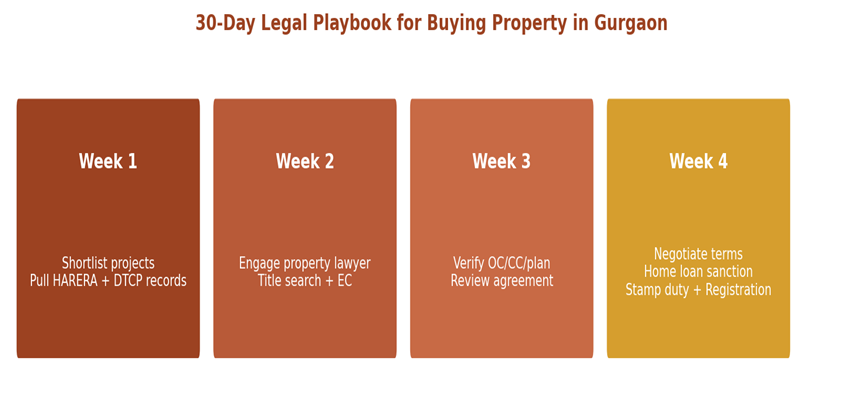
Figure 2.4 – The 30-day playbook: what to do in each of the four weeks before you sign.
Conclusion: Legal Discipline Is Compounding Wealth Protection
Every rupee spent on legal due diligence is capital insurance. A comprehensive title search costs Rs. 10,000-25,000; a good property lawyer charges Rs. 25,000-75,000 for end-to-end transaction handling. Against a Rs. 2-5 crore purchase, this is 0.1 percent to 0.4 percent of the ticket size – the cheapest insurance you will ever buy. Buyers who bypass these checks save nothing; they simply defer a much larger cost.
If you take one message away from this guide, let it be this: buying property in Gurgaon is a legal transaction dressed up as a lifestyle purchase. Treat the legal side as primary, the emotional side as secondary, and you will own a home you can rest in – not a dispute you have to defend.