

Last year, a buyer I know did everything by the book. He checked the RERA number. He visited the sample flat twice. He liked the sector. He booked a ₹6 Cr apartment feeling confident. Eighteen months later, he discovered the actual carpet area was nearly 30% smaller than the size he thought he was paying for, the maintenance bill was ₹16,000 a month, and the possession date in his agreement was a full two years later than what the sales team had promised verbally.
He didn’t do anything wrong. He just didn’t know what to check.
Here’s the thing about buying luxury in Gurgaon — it doesn’t work like mid-segment buying. The ticket size is bigger, the contracts are more complex, and the margin for error is much smaller. A mistake that costs ₹2 lakh on a ₹80 lakh flat can cost ₹40 lakh on a ₹6 Cr one.
This checklist covers the things most buyers skip — not the obvious stuff everyone knows, but the gaps that quietly cost people money or peace of mind.
Before You Even Shortlist — Get This Right First
Before you look at a single project, two decisions will shape everything that follows. Get these wrong and no checklist will save you.
Define What the Property Actually Needs to Do for You
Are you going to live in it? Rent it out? Hold it and sell in a few years? These are completely different decisions, and they point to completely different flats.
A Golf Course Road apartment makes sense if you want prestige and you’re going to live there — that address carries weight. But a Dwarka Expressway flat at the same budget might give an investor better rental yield, because newer corridors often have lower entry prices with rising tenant demand.
If you don’t decide what the property is for, you’ll get swayed by whichever developer’s salesperson you happen to meet last. Decide first. Shortlist second.
Know Your Actual All-In Budget — Not Just the Sticker Price
In Gurgaon’s luxury segment, the base price is almost never the final price. Before you fall in love with a number on a brochure, ask for these line items in writing:
- GST — 5% on under-construction flats. On a ₹6 Cr flat, that’s ₹30 lakh on its own.
- PLC (Preferred Location Charges) — an extra charge for a better unit: a higher floor, a park-facing view, or a corner flat.
- EDC/IDC (External & Internal Development Charges) — government levies on infrastructure that the builder passes on to you.
- Club membership and maintenance deposits — often 2–3 years of maintenance collected upfront.
- Stamp duty and registration — typically 5–7% of property value in Haryana. On a ₹5 Cr+ flat, that’s ₹30–50 lakh by itself.
My rule: add 10–15% to the base price as a working budget buffer. If the add-ons come in lower, great. If not, you won’t be blindsided at signing.
The Checklist — What Most Buyers Skip
This is the part that matters. Go through every point — not just the ones that feel convenient.
1. Check the Builder’s Delivery Track Record — Not Just the Brand Name
In Gurgaon, a famous name does not guarantee on-time delivery. Some of the biggest developer brands have delayed projects by 3–5 years. Some lesser-known ones have quietly delivered on schedule, project after project.
What to do: Ask for the developer’s last 3–5 delivered projects by name. Look them up on the HRERA portal (HRERA is Haryana’s Real Estate Regulatory Authority — the government body that regulates builders here). Compare the promised possession date with the actual handover date. That gap tells you more than any brochure.
At ₹5 Cr+, you’re trusting this builder with your money for 3–5 years. Builder reputation is something you verify, not something you assume.
2. Understand Carpet Area — Not Super Built-Up Area
This is the single most misunderstood thing in Indian real estate, and in luxury flats the gap is huge — often 25–35%.
- Super built-up area = your flat’s floor area + walls + your share of common spaces like lobbies, staircases, and lift shafts.
- Carpet area = the actual usable floor space inside your flat, where you could literally lay a carpet. RERA legally requires builders to disclose this number.
In practice, a flat advertised as 3,000 sq. ft. super built-up might give you only 2,100–2,200 sq. ft. of real living space.
What to do: Always ask for the RERA carpet area figure, and compare projects on that — never on the marketed super built-up size. Two flats can show the same “3,000 sq. ft.” and have very different real space.
3. Verify RERA Registration — and Go Beyond the Number

Most buyers confirm a RERA number exists and stop there. That’s step one of five.
On hrera.org.in (Haryana’s official RERA site), also check:
- Is the possession date RERA-registered? This is the legally binding date — not the one in the brochure.
- Are there complaints filed against the developer on this specific project?
- Is the escrow account active? RERA requires 70% of buyer money to go into a separate escrow account — a locked account that can only be spent on that project’s construction. It protects your money if work stalls.
- Is the approved layout plan the same as what’s being sold to you?
Be careful with new launches marked “RERA applied” rather than “RERA registered.” Never pay a booking amount before the actual RERA number is issued.
4. Evaluate Location Premium Honestly — Not Just the Sector Number
In Gurgaon, the same sector can hold very different micro-locations. One plot sits right on the main corridor; another is 2 km inside a narrow lane with poor connectivity. Same sector number, very different daily life.
What actually creates a location premium in Gurgaon’s luxury market:
- Metro connectivity — proximity to Rapid Metro or the Yellow Line.
- Distance to employment hubs — Cyber City, Udyog Vihar, Golf Course Road.
- Road access — is it directly on a main corridor (Golf Course Road, GCER, SPR, Dwarka Expressway) or tucked behind one?
- Established vs upcoming — an established corridor like Golf Course Road holds resale value better than a newer one, even if the newer one looks cheaper today.
What to do: Visit the site at peak traffic — a weekday at 9 am, not a quiet Sunday morning. The commute you’ll actually live with tells you more than any location map.
5. Compare Amenities vs Actual Value — Don’t Get Distracted by the List
Gurgaon brochures love big numbers — “101 amenities,” “Olympic pool, mini theatre, five badminton courts.” Here’s the honest truth: most residents regularly use three to five amenities. A longer list usually just means a higher monthly maintenance bill, because every facility needs upkeep — paid by residents, every month.
What to actually check:
- The quality of the clubhouse, not the quantity of features listed.
- The estimated monthly maintenance charge per sq. ft. At ₹4–6/sq. ft. on a 3,000 sq. ft. flat, that’s ₹12,000–18,000 a month. On a 5,000 sq. ft. unit, more. This is a real, lifelong cost.
- Whether amenities are operational or only “promised for possession.” In ready-to-move projects, walk over and see what’s actually running. In under-construction ones, get written confirmation of what will be delivered and by when.
Amenities add to your lifestyle — and to your monthly costs for life. Ask upfront.
6. Assess Density — How Many Families Will You Actually Share the Building With?
This is the most underrated factor in luxury buying, and in Gurgaon it varies enormously. Density means units per acre and units per floor.
In Gurgaon’s true luxury tier, you’ll find projects with just 2–4 units per floor — fewer neighbours on your level, shorter lift waits, quieter corridors, more privacy. Compare a project with 500 units on 5 acres against 200 units on 5 acres: the shared amenities, parking, and overall feel are completely different, even at a similar price per sq. ft.
What to ask: total units in the project, units per floor in your specific tower, and the parking ratio — total parking slots versus total units. Parking is a daily-life issue you’ll feel every evening.
7. Understand the Payment Plan — and What Happens If You Miss a Milestone
Gurgaon’s luxury payment plans vary widely: 10:80:10, 20:80, 30:40:30, construction-linked, subvention plans. Each one carries different cash flow and different risk. Most buyers read the booking amount and skip the rest.
Verify in writing:
- The specific construction milestones tied to each payment.
- The penalty or interest if you miss a payment deadline.
- Which banks have approved this project for home loans. Not all luxury projects are bank-approved — especially pre-launches.
- If there’s a subvention plan (where the builder pays your loan EMIs during construction), understand that you are still the borrower. If the builder stops paying, the bank comes after you, not them.
The safest structure is usually construction-linked — your money goes out only as work actually gets done. Understand exactly what you’re signing before you sign it.
8. Evaluate Resale Potential Before You Buy — Not After
Even if you plan to live here forever, think about who would buy this from you in 7–10 years. That mindset protects your money.
What drives resale potential in Gurgaon’s luxury market:
- Corridor demand — Golf Course Road and GCER have historically held stronger resale demand than newer corridors.
- Developer brand with a delivered track record — these command better resale prices.
- Low density and low unit count — scarcity drives premium. A 150-unit project tends to resell better than a 1,500-unit one in the same sector.
- Construction and maintenance quality — a well-run building holds value; a poorly maintained one slides regardless of location.
- Configuration — 3 BHK and 4 BHK units typically move faster in resale than penthouses or very large 5 BHKs. The most liquid product isn’t always the biggest one.
What to do: Ask your agency to show you actual registered secondary-market sale prices near the project — not asking prices. Registered prices show what the market is really paying.
9. Read the Sale Agreement — Not Just the Brochure
At ₹3 Cr+, a surprising number of buyers still sign the Sale Agreement without a lawyer reading it. That’s a real risk.
In the agreement — not the brochure — check:
- Is the possession date exactly as RERA-registered? Brochure dates aren’t legally binding; only the registered date is.
- Are all promised specifications (flooring, AC brand, fittings) written into the agreement?
- What are the penalty clauses if the builder delays possession?
- Is the payment schedule identical to what was discussed verbally?
- What’s the process for the Occupancy Certificate (OC) — the government’s confirmation that the building is legally fit to live in? You need it before you can legally move in or sell.
The brochure is marketing. The agreement is law. Anything not in the agreement does not protect you.
10. Visit the Actual Site — Not Just the Sample Flat
Sample flats are professionally staged and lit to impress, not to inform. Go see the actual floor and the actual direction of the unit you’re booking.
On a real visit, check:
- The actual view from your floor — not the top-floor view of the sample flat.
- Sun direction at the time of day you’ll be home. Some west-facing units turn oven-hot in Gurgaon summers.
- Construction quality on completed floors — finishes, waterproofing, beam work.
- The neighbourhood as it is today, not as the master-plan render promises.
- If ready-to-move: walk the common areas, test the lifts, look at how clean and maintained things are. That shows you how the RWA (Resident Welfare Association — the residents’ body that runs the property) actually manages the place.
The Quick-Reference Checklist
| # | What to Check | What to Ask / Where to Check | Most Buyers Skip This? |
|---|---|---|---|
| 1 | Builder track record | HRERA portal — past project delays | Yes |
| 2 | Carpet area (RERA) | Ask for RERA carpet area disclosure | Yes |
| 3 | RERA details (beyond no.) | hrera.org.in — complaints, escrow, possession date registered | Yes |
| 4 | Location micro-check | Site visit at peak traffic time | Often |
| 5 | Amenities vs maintenance | Ask for maintenance charge estimate | Yes |
| 6 | Project density | Units per acre + units per floor | Yes |
| 7 | Payment plan fine print | Bank approvals + penalty clauses | Yes |
| 8 | Resale potential | Actual registered transactions near the project | Yes |
| 9 | Sale Agreement review | Hire a property lawyer before signing | Very Often |
| 10 | Real site visit | Visit actual unit floor/direction | Often |
Save this table. Before you book anything above ₹3 Cr in Gurgaon, go through this list point by point — not just the ones that feel convenient.
The Gurgaon-Specific Mistakes Buyers Make
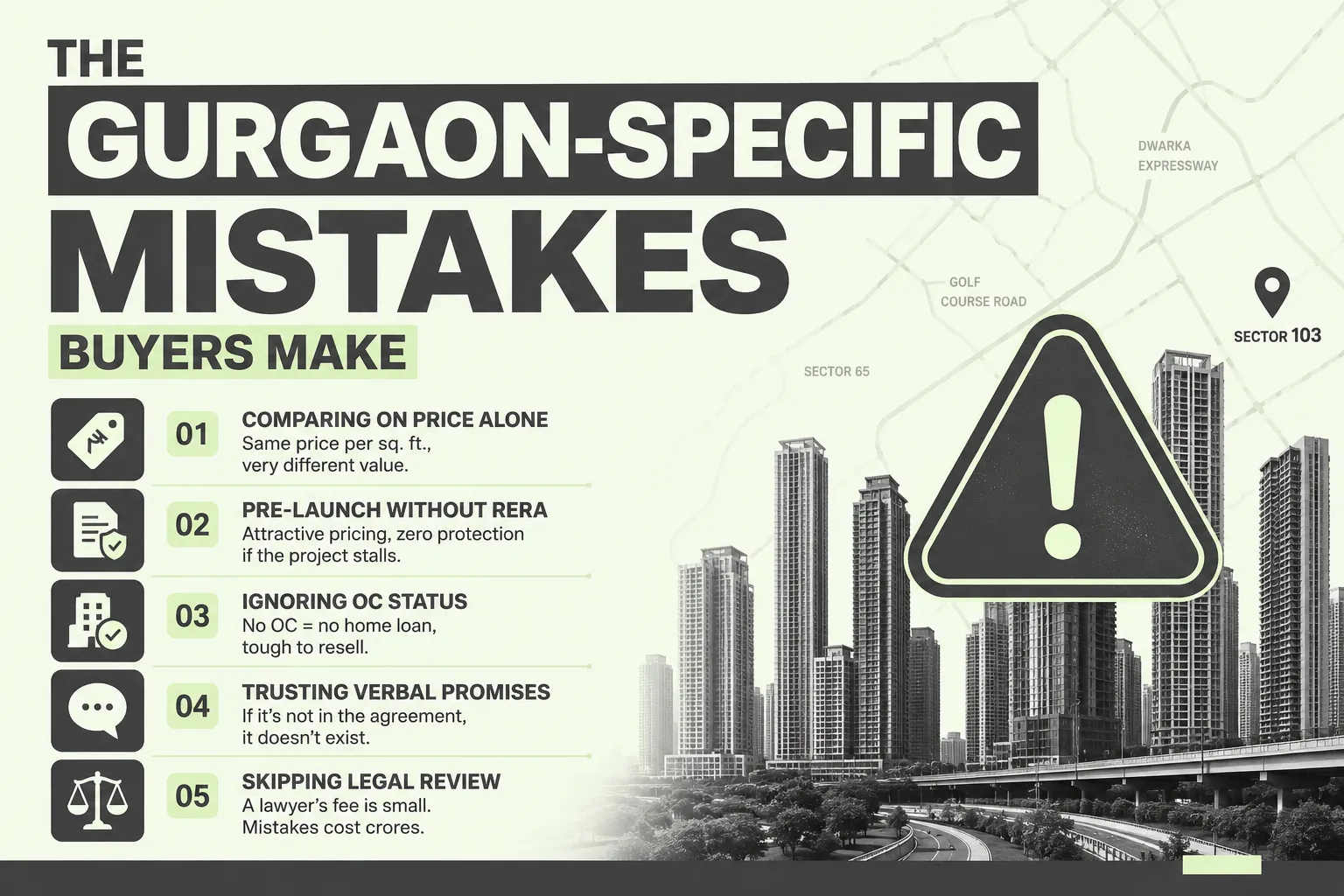
Mistake 1: Comparing projects on price per sq. ft. alone. ₹20,000/sq. ft. in Sector 65 and ₹20,000/sq. ft. in Sector 103 are not the same product or the same investment. Corridor, connectivity, developer, and density decide whether that price is fair or inflated. Always compare with context.
Mistake 2: Booking in a pre-launch without RERA registration. “Pre-launch pricing” sounds attractive, and sometimes it genuinely is. But paying before RERA registration leaves you with limited legal protection if the project stalls. Wait for the RERA number — the discount rarely justifies the exposure.
Mistake 3: Ignoring OC status on “ready-to-move” projects. Some ready-to-move flats in Gurgaon are handed over without an Occupancy Certificate. Without an OC, you can’t get a home loan on the property, and reselling later gets complicated. Always confirm OC status before buying.
Mistake 4: Trusting verbal commitments from sales teams. “The view won’t be blocked,” “the club will be ready at possession,” “no extra charges” — none of it means anything unless it’s in the Sale Agreement. Write it, or it doesn’t exist. This matters at every price point, especially above ₹5 Cr.
Mistake 5: Skipping independent legal review. Most ₹5 Cr+ buyers still don’t hire their own property lawyer to review the agreement. A lawyer’s fee is a tiny fraction of the property value — and it can save you from mistakes that cost far more. Don’t skip it.
Before You Decide
Buying luxury property in Gurgaon is one of the biggest financial decisions you’ll ever make — and the market moves fast, which is exactly why it’s so easy to rush past a checklist like this. Knowing how to choose the right luxury apartment in Gurgaon isn’t about finding the flashiest brochure; it’s about verifying the boring details before you commit.
So take your time on these points. The right project at the right price, properly checked, is worth far more than the fastest deal with the most impressive sample flat.
If you’re ready to start comparing verified options, browse our curated Luxury Apartments Gurgaon for Sale listings — all from credible developers. And if your budget is ₹5 Cr and above, our Premium Flats Above 5 Crore Gurgaon guide covers the best active options across GCER, SPR, and Dwarka Expressway.
And if you have questions before you decide — just reach out. We’d rather spend an hour helping you choose right than close a deal that doesn’t fit your needs.