

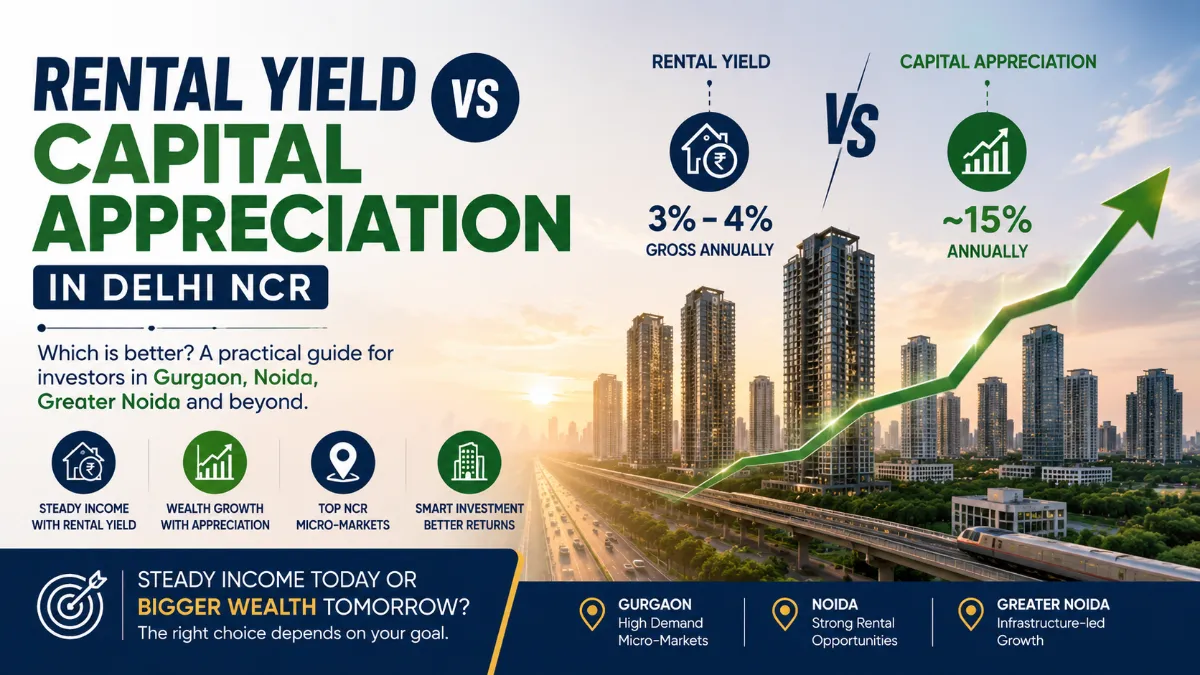
Which is better? A practical guide for investors in Gurgaon, Noida, Greater Noida and beyond.
If you are buying property in Delhi NCR, you are really placing one of two bets. Either you want the property to earn you a steady monthly rent, or you want its value to jump so you can sell it for a higher price a few years down the line. Investors call these two returns rental yield and capital appreciation, and the smart money in NCR is usually chasing one much harder than the other. At NeemInfra, we help homebuyers and investors understand both strategies so they can make informed real estate investment decisions based on their financial goals, risk appetite, and long-term wealth creation plans.
Here is how the two stack up in today market, and how to decide which one deserves your capital.
The Two Numbers That Matter
Rental yield is the annual rent a property earns as a percentage of its price. If a INR 1.2 crore flat in Noida rents for INR 30,000 a month, that is INR 3.6 lakh a year, or a gross yield of 3%.
Capital appreciation is the growth in the property market value over time. That same flat, bought at INR 1.2 crore in 2021, may be worth INR 1.6 crore today, an appreciation of around 33% over five years.
Both are real returns. But in NCR, they behave very differently.
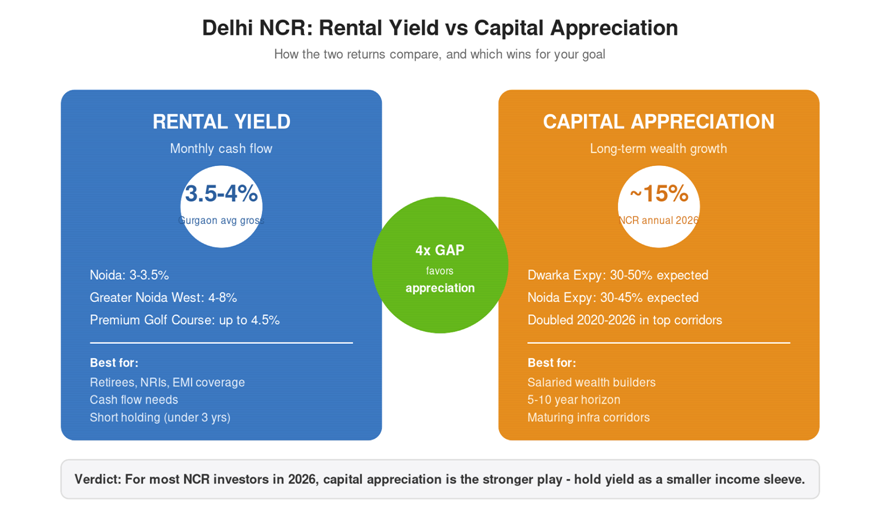
Figure 1: Delhi NCR at a glance – rental yield vs capital appreciation
What Delhi NCR Actually Delivers
Rental yields across the region sit in a fairly narrow band. Gurgaon leads at roughly 3.5 to 4% gross, with premium micro-markets like Golf Course Road and DLF phases occasionally touching 4 to 4.5%. Noida averages 3 to 3.5%, and Greater Noida West can range anywhere between 4% and 8% depending on the pocket and the type of unit.
Capital appreciation tells a much louder story. Dwarka Expressway prices nearly doubled between 2020 and 2026, moving from roughly INR 9,400 per sq ft to over INR 18,600. Noida Expressway climbed about 152% in the same period to around INR 14,900 per sq ft. Forecasts for 2026 put expected appreciation on Dwarka Expressway at 30 to 50% and Noida Expressway at 30 to 45%, driven by Jewar Airport, metro extensions, and infrastructure catching up with demand. NCR is expected to lead India this year with roughly 15% annual price growth.
Do the math and the gap is obvious. A 3.5% rental yield versus 15% price growth means capital appreciation is doing more than four times the work.
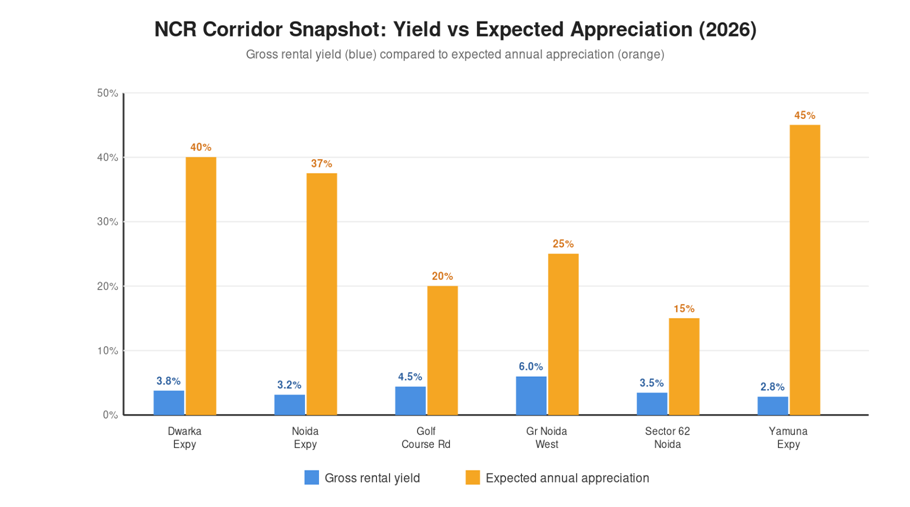
Figure 2: Yield vs expected appreciation across major NCR corridors (2026)
Side-by-Side Comparison
| Parameter | Rental Yield | Capital Appreciation |
| Typical NCR return (2026) | 3-4% gross annually | ~15% annually |
| Best micro-markets | Golf Course Rd, Sector 62 Noida, Greater Noida West | Dwarka Expy, Noida Expy, Yamuna Expy, Sector 150 |
| Payout style | Monthly cash | Lump-sum at exit |
| Liquidity | Consistent, verifiable | Illiquid, unrealized until sale |
| Tax treatment | Slab rate (up to 30%+) | 12.5% LTCG (held >2 yrs) |
| Ideal holding period | 1-3 years | 5-10 years |
| Risk profile | Lower, demand-driven | Higher, cycle-sensitive |
| Best for | Retirees, NRIs, EMI cover | Salaried wealth builders |
| Sensitive to | Vacancy, tenant quality, maintenance | Infra delivery, policy, exit timing |
| Verdict | Steady income sleeve | Primary growth engine |
Where Rental Yield Wins
Yield is not dead. It wins when you need cash flow rather than paper gains. Retirees, NRIs looking for rupee income, and investors who need the property to service its own loan EMI all care about monthly rent more than exit price.
Yield also wins in specific pockets. Compact 1BHK and 2BHK units near office corridors in Sector 62 Noida, Cyber City fringe areas, and Golf Course Extension often out-yield larger premium units because their absolute ticket size is lower and tenant demand is deep. Co-living conversions and serviced apartments push effective yields to 6 to 7% for operators who can handle the churn.
The other quiet advantage of yield: it is measurable from month one. You can verify it. Appreciation is a forecast until you sell.
Where Capital Appreciation Wins
For most NCR investors with a 5 to 10 year horizon, appreciation is where the real money is. Three reasons stand out.
Infrastructure is compounding. Jewar Airport opening in phases, the Delhi-Mumbai Expressway spurs, the RRTS corridor to Meerut, and metro extensions across Noida and Gurgaon keep pulling formerly peripheral land into the primary market. Land near confirmed infrastructure has historically returned 20 to 40% a year in NCR during delivery cycles.
End-user demand has replaced speculation. Post-RERA, the buyers absorbing new premium launches on Dwarka Expressway and Sector 150 Noida are largely end-users and upgraders. That is a structurally healthier demand base than the investor-flip market of 2010 to 2013, and it makes the appreciation more durable.
Tax treatment favors it. Long-term capital gains on property held over two years are taxed at 12.5% (without indexation). Rental income is taxed at your slab rate, which for most working professionals in NCR is 30% plus surcharge. Every rupee of appreciation keeps more of itself than every rupee of rent does.
The Honest Trade-Off
Appreciation looks better on almost every metric in NCR right now, but it comes with three catches worth naming.
It is illiquid. You cannot sell 10% of a flat when you need cash. Rent, by contrast, arrives every month.
It is unrealized until exit. A 40% price rise on paper means nothing until a buyer signs and funds transfer. Exit timing matters, and NCR has had multi-year flat stretches (2014 to 2019) between its booms.
It is location-specific. The average NCR appreciation figure hides enormous variation. A wrongly chosen sector in the wrong micro-market can underperform inflation for a decade, while the sector next door doubles.
A Framework for Choosing
What is your holding period? Under 3 years, prioritize yield because appreciation may not have compounded enough to cover transaction costs of 8 to 10%. Over 5 years, prioritize appreciation.
Do you need the monthly income? If the rent is part of your household cash flow, yield is not optional. If you are salaried and the property is a wealth-building bucket, appreciation compounds harder.
Maturing or mature corridor? Maturing corridors (Dwarka Expressway, Yamuna Expressway, Noida Sector 150) reward appreciation buyers. Mature corridors (South Delhi colonies, established Gurgaon sectors, Noida Sectors 50 to 62) tend to offer better rental predictability but slower price growth.
The Verdict for Delhi NCR
For most investors in 2026, capital appreciation is the stronger play. NCR is in a genuine up-cycle driven by real infrastructure and real end-user demand, and the yield gap is too wide to ignore, roughly 4x in favor of price growth. Buy on a delivering infrastructure corridor, hold for 5 to 7 years, and let compounding do the work.
Yield-first buys make sense as a smaller allocation, particularly for cash flow needs or as compact units in established rental micro-markets. But treat them as the income sleeve of your real estate portfolio, not the growth engine.
The best NCR portfolios usually hold both. One flat near Cyber City that pays its own EMI, and one plot or under-construction unit on a maturing expressway that quietly doubles while you sleep.
Frequently Asked Questions
Q1. What is a good rental yield in Delhi NCR?
Anything above 3.5% gross is considered healthy for premium residential stock. Yields between 4% and 6% are achievable in Greater Noida West, builder floors near office corridors, and compact 1BHK units near metro stations. Above 6% usually implies a co-living or serviced-apartment operating model, not a passive lease.
Q2. Which NCR corridor offers the best capital appreciation right now?
Dwarka Expressway in Gurgaon and Noida Expressway (particularly Sectors 150, 143, 144) are the front-runners. Yamuna Expressway is the medium-term dark horse, driven by Jewar Airport phasing. Historically, these corridors have delivered 30 to 50% appreciation over a delivery cycle.
Q3. Should I buy under-construction or ready-to-move for appreciation?
Under-construction on a maturing corridor typically appreciates faster (10 to 20% payment discount plus construction-linked price rise), but carries execution risk. Stick to RERA-registered projects from developers with a delivery track record. Ready-to-move suits yield-focused buyers because you can lease from month one.
Q4. Do rental yields cover the EMI on a Delhi NCR home loan?
Almost never in premium locations. At a 3.5% gross yield versus a 8.5 to 9% home loan rate, the rent covers roughly 40 to 45% of the EMI on a 70 to 80% financed property. The gap is bridged by your salary, tax benefits under 24(b) and 80C, and eventual appreciation.
Q5. Is commercial real estate a better bet than residential for yield?
Yes, in most cases. Grade-A commercial rentals in Cyber City, Sector 62 Noida, and Golf Course Extension deliver 7 to 9% yields with longer lock-ins and lower tenant churn. Ticket sizes start at INR 60 to 80 lakh via fractional ownership platforms, so the entry barrier is lower than it used to be.
Q6. How does GST and stamp duty affect my true return?
Under-construction properties attract 5% GST (1% for affordable). Stamp duty in Delhi is 4 to 6%, Haryana 5 to 7%, Uttar Pradesh 5 to 7%. Total acquisition friction runs 8 to 12% of the purchase price. Factor this in when computing net appreciation, especially for short holds.
Q7. When is the right time to exit for appreciation?
Watch three signals: infrastructure completion (post-metro opening, post-highway commissioning), a spike in new launch pricing in your micro-market (5 to 10% jumps in 2 quarters), and rental-yield compression below 3% (a sign prices have overshot fundamentals). Any two together usually mark a good exit window.
Q8. Can I get both good yield and good appreciation in the same property?
Rarely. High-yield stock is typically in mature or peripheral markets where price growth has slowed. High-appreciation stock is on developing corridors where rental demand has not fully built up. The pragmatic answer is portfolio-level diversification, not one perfect property.