

If you’ve been parking money in fixed deposits and watching inflation eat the returns, Gurgaon’s rental market is the conversation you’ve been missing. The city doesn’t just promise capital appreciation — it hands you a monthly cheque while your property value climbs. But not every sector behaves the same. A 3BHK in Sector 42 and a 3BHK on Dwarka Expressway tell two very different stories when you sit down with the numbers.
This blog breaks down where rental yield Gurgaon property actually performs, which rental hotspots Gurgaon is known for, how tenant demand shapes each micro-market, and a simple ROI calculation you can run on any flat before you sign the cheque.
What Is rental yield Gurgaon property and Why It Matters
Rental yield is the annual rent your property earns, expressed as a percentage of its purchase price. It’s the income side of real estate — separate from appreciation, which is the value-growth side. A property that costs ₹1.5 crore and rents for ₹75,000 a month gives you a gross yield of 6%. That’s the number banks, REIT analysts, and seasoned investors track before they call anything an “investment” rather than a “speculation.”
Gurgaon sits in an interesting bracket. National averages for residential yield hover around 1.5–2.5%, but select pockets of Gurgaon push into the 3–6% range because of concentrated corporate employment. The Magicbricks residential rental research notes that more than 30% of rental properties in cities like Gurgaon fall in the 1,500–2,000 sq.ft. segment — the sweet spot for working-professional tenants.
The point: rental yield Gurgaon property isn’t uniform. It’s hyperlocal. Two sectors five kilometres apart can deliver wildly different monthly income for the same ticket size.
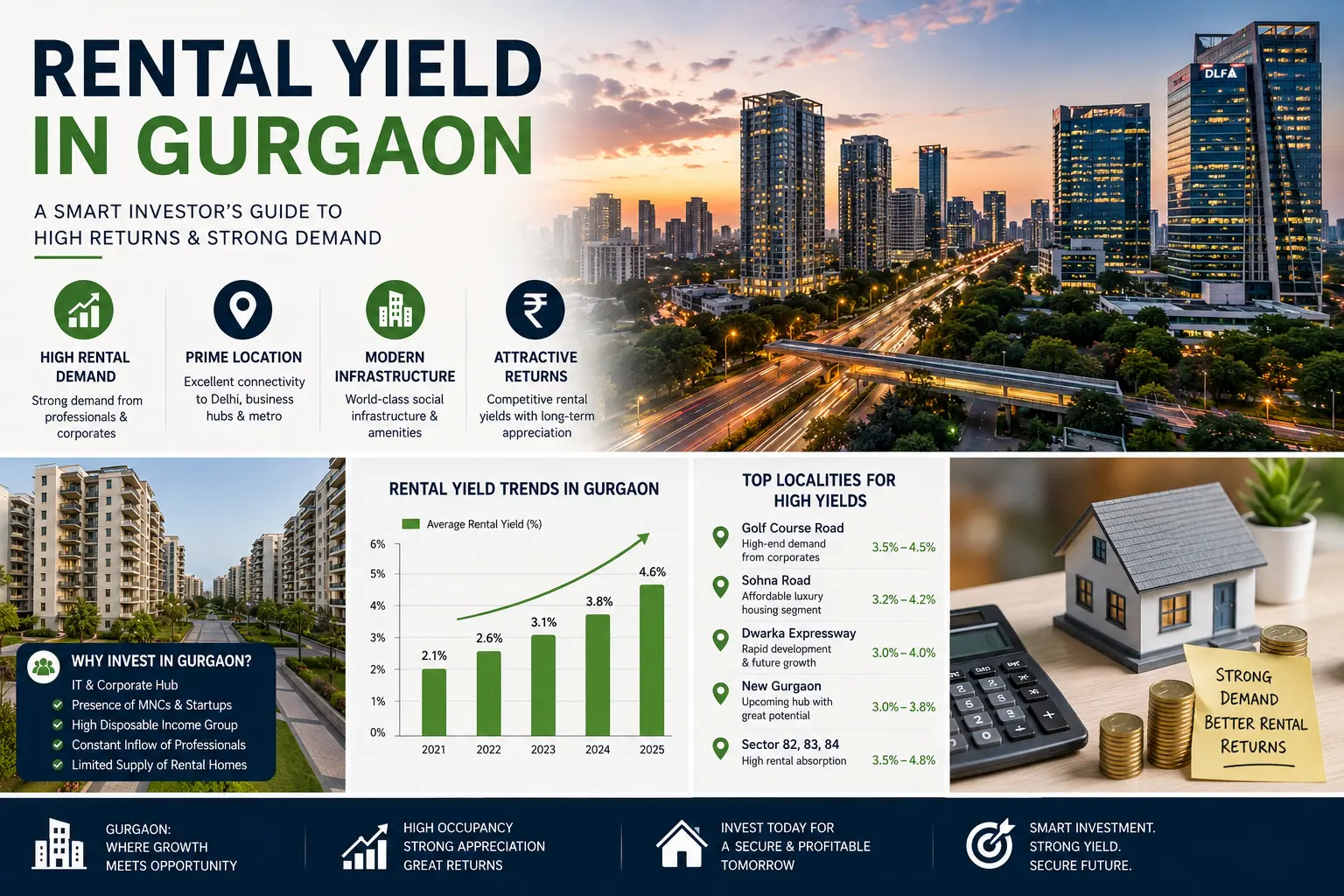
Top rental hotspots Gurgaon Offers in 2026
Sector 42 – The Golf Course Road Luxury Belt
Sector 42 is the address people pay a premium to write on a visiting card. Sitting along Golf Course Road, it places tenants within minutes of DLF Cyber City and Udyog Vihar — two of the largest employment hubs in the NCR. The housing stock here leans heavily toward high-end 4BHK apartments, and rents for these units range from ₹1.2 lakh to ₹16.5 lakh a month depending on the project and floor. That spread alone tells you the tenant pool is deep at both the senior-executive and HNI levels. Madhyam’s 2024 rental income analysis ranks Sector 42 among the top localities for investors chasing large monthly cheques.
[Image blocked: Alt text – Luxury 4BHK apartment building exterior in Sector 42 Gurgaon, manicured landscaping, Golf Course Road location, premium residential tower]
The catch: ticket sizes are steep. A 4BHK here can cost ₹5 crore and up, so even a ₹3 lakh monthly rent translates to a yield closer to 4–5%. You’re trading yield percentage for absolute rupee income and stronger capital appreciation.
DLF Phase 2 & Phase 3 – The Corporate-Adjacent Belt
If Sector 42 is the luxury end, DLF Phase 2 and 3 are the workhorse end. These phases sit next to Cyber City, with metro access via Phase 3 and Belvedere Towers stations, and direct connectivity to NH-48. The housing mix is broader — builder floors, smaller apartments, and mid-segment flats — which widens the tenant funnel.
Rents in DLF Phase 3 range from ₹40,000 to ₹10 lakh a month for larger units, while DLF Phase 2 builder floors typically rent between ₹62,000 and ₹3.5 lakh. The 4BHK builder floor is the workhorse product here, popular with senior professionals who want space and proximity without the Sector 42 price tag. These phases are among the most consistently cited rental hotspots Gurgaon investors return to, because vacancy cycles are short and tenant quality is high.
Sector 54 – The Rising Mid-Premium Choice
Sector 54 has quietly become a serious contender. It hosts co-working spaces like Centrum Plaza, Paras Twin Towers, and Suncity Business Tower, and sits within a 9 km radius of both DLF Cyber City and Udyog Vihar. That proximity keeps tenant demand steady — tenants don’t have to choose between a good apartment and a short commute.
What makes Sector 54 interesting for 2026 is the development momentum. Established infrastructure plus new inventory means you’re buying into a market that’s still pricing in future demand, not one that’s already plateaued. For investors who want appreciation upside alongside healthy monthly income, it sits in the sweet spot between Sector 42’s luxury bracket and DLF Phase 2’s mature stock.
Golf Course Road, MG Road & Cyber City – The Premium Commercial-Adjacent Strip
Golf Course Road, MG Road, and Cyber City form the spine of Gurgaon’s premium residential-commercial corridor. MG Road, in particular, carries some of the finest commercial buildings in the city and is a favourite for investors targeting retail and office space alongside residential. The Growmax Wealth Gurgaon ROI analysis places overall Gurgaon property ROI in the 6–12% per annum band, with this corridor sitting at the higher end because of corporate tenant density.
For a deeper read on yields specifically, Intel Realty’s rental yield data is worth bookmarking as a reference benchmark.
Understanding tenant demand Across Micro-Markets
tenant demand isn’t a vague vibe — it’s a function of three things: proximity to offices, transport, and lifestyle infrastructure. Gurgaon’s rental market is almost entirely employment-driven, which means tenant pools cluster around corporate clusters rather than transport nodes alone.
| Micro-market | Primary tenant profile | Typical lease tenure | Vacancy risk |
| Sector 42 | Senior executives, HNIs, expats | 2–3 years | Low |
| DLF Phase 2 & 3 | Mid-to-senior professionals, small families | 11 months–2 years | Low |
| Sector 54 | Mid-level professionals, young families | 11 months–2 years | Moderate |
| Golf Course Road | Senior corporate, diplomatic, expat | 2–3 years | Low |
| Dwarka Expressway | First-home renters, young professionals | 11 months | Moderate–High |
Shorter leases mean more turnover cost (brokerage, painting, gap periods). Longer leases mean steadier income but slightly slower rent escalation. Balance this against the yield number, not in isolation from it.
ROI calculation – How to Work Out Your Real Returns
Most investors stop at rental yield and call it a day. That’s the first mistake. A proper ROI calculation layers in maintenance, taxes, vacancy, and appreciation. Here’s a workable framework:
Gross rental yield = (Annual rent ÷ Property price) × 100
Net rental yield = ((Annual rent − maintenance − property tax − insurance − 1 month vacancy) ÷ Property price) × 100
Total ROI (3-year horizon) = ((Cumulative net rent + Appreciation at sale − transaction costs) ÷ Initial investment) × 100
| Example (₹) | Sector 42 (4BHK) | DLF Phase 2 (4BHK floor) | Sector 54 (3BHK) |
| Purchase price | 6,00,00,000 | 3,50,00,000 | 2,00,00,000 |
| Monthly rent | 3,00,000 | 1,75,000 | 85,000 |
| Gross yield | 6.0% | 6.0% | 5.1% |
| Annual costs (maint., tax, etc.) | 4,80,000 | 2,80,000 | 1,40,000 |
| Net yield (after 1 month vacancy) | ~4.9% | ~4.9% | ~4.1% |
Figures are illustrative; actual numbers vary by project, floor, and condition.
The takeaway from any honest ROI calculation: the percentage yield looks similar across brackets, but the absolute monthly income and appreciation potential diverge sharply. A 4.9% net yield on ₹6 crore is a very different investment thesis from 4.1% on ₹2 crore.
Areas to Watch: Dwarka Expressway, Sohna Road & New Gurgaon
If the corridors above are the established plays, Dwarka Expressway, Sohna Road, and New Gurgaon are where appreciation is still being priced in. These belts carry higher vacancy risk in the short term — infrastructure is still maturing, and tenant pools are shallower — but they offer entry tickets that the Golf Course Road corridor hasn’t seen in years. Investors with a 5–7 year horizon and a stomach for slower initial leasing often find these markets rewarding. For first-time investors exploring Gurgaon’s broader landscape, our Gurgaon property investment guide walks through the corridor-by-corridor comparison in more detail.
Risks and Caveats Worth Naming
- Yield compression in overheated pockets. When prices rise faster than rents, yields fall. Sector 42 has seen this — ticket sizes have climbed faster than rents in the last two cycles.
- Tenant turnover costs. An 11-month lease that breaks every year costs you roughly 2–2.5 months of income in brokerage, repainting, and gap periods.
- Regulatory noise. Rent control, lease registration, and RERA-linked disclosure norms shift. Always verify the latest position before you commit.
- Liquidity. Real estate is not a mutual fund. Exit timing matters; distressed sales erode returns quickly.
This isn’t licensed financial advice — for high-ticket decisions, talking to a registered advisor is the sensible move.
Frequently Asked Questions (FAQ)
Q1. What is a good rental yield in Gurgaon?
A gross yield of 3–4% is solid for premium Gurgaon residential, and 4–6% is strong for mid-segment builder floors near corporate hubs. Anything above 6% usually signals either an underpriced asset, a higher-risk micro-market, or a data error worth re-checking.
Q2. Which are the best rental hotspots Gurgaon has for 2026?
A. Sector 42, DLF Phase 2 and 3, Sector 54, and the Golf Course Road–MG Road corridor remain the steadiest. Dwarka Expressway and Sohna Road are higher-upside, higher-vacancy options.
Q3. How do I calculate ROI on a rental property in Gurgaon?
A. Use the ROI calculation framework above: start with gross yield, deduct annual costs and one month of vacancy for net yield, then add appreciation and subtract transaction costs for total ROI over your holding period.
Q4. Is tenant demand in Gurgaon stable year-round?
A. tenant demand peaks between March and July, when corporate transfers and new hires land. October–December typically slows. Plan lease renewals to avoid the December gap.
Q5. Should I invest for rental yield or capital appreciation?
A. They aren’t mutually exclusive, but they pull in different directions. Luxury pockets give you lower percentage yield but stronger absolute income and appreciation. Mid-segment belts give you higher percentage yield but thinner appreciation. Pick based on your cash flow needs, not on what’s trending.
Q6. Are builder floors better than apartments for rental income?
A. Builder floors typically yield slightly higher because they’re priced lower per square foot, but they carry more maintenance responsibility and sometimes lower tenant quality. High-rise apartments from tier-1 developers command premium rents and longer leases.