

Why Timing Beats Location (Sometimes)
Real estate wisdom says Location! Location! Location! But investors who bought property in Gurgaon in 2013 at the peak of the last cycle waited nearly 7 just to break even. Those who bought property new launch projects in Gurgaon in mid-2020, after a decade-long stagnation, saw values almost double by 2024. The lesson is inescapable: timing is not everything, but it is the difference between a mediocre return and a life-changing one. This guide walks you through when to buy property in Gurgaon, what signals to watch, which quarters historically deliver the best entry prices, and how to align micro-market cycles with your personal financial timeline.
We will unpack macro cycles, seasonality, ready-versus-under-construction premiums, interest-rate sensitivity, and micro-market divergence. Every claim is tied to a table or chart, so you can pressure-test the reasoning before you commit crores to a decision.
Whether you are a first-time end-user searching for a home in Sector 63 or a seasoned investor deciding whether to buy property in Gurgaon on Dwarka Expressway or SPR, the framework below applies.

The Gurgaon Cycle – A 15-Year Retrospective
Before you buy property in Gurgaon, you need to internalize how the city moves. Since 2010, Gurgaon has completed roughly 1.5 property cycles. Prices climbed sharply from 2010 to 2013, plateaued from 2014 to 2019, and re-accelerated from 2021 onward. Understanding where we are in the current cycle is the single most important factor when you decide to buy property in Gurgaon.
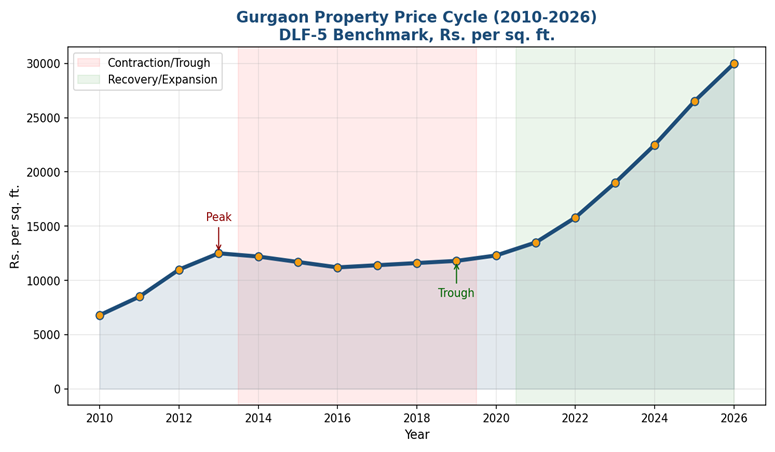
Figure 1.1 – Gurgaon property price cycle showing peak (2013), trough (2018-2019), and current late-expansion phase.
Table 1: Gurgaon Price Cycle Snapshot (Rs. per sq. ft., DLF-5 benchmark)
Illustrative benchmark tracking a premium micro-market since 2010.
| Year | Avg Price/sqft | YoY Change | Cycle Phase |
| 2010 | 6,800 | +18% | Expansion |
| 2013 | 12,500 | +8% | Peak |
| 2016 | 11,200 | -3% | Contraction |
| 2019 | 11,800 | +1% | Trough |
| 2021 | 13,500 | +11% | Recovery |
| 2023 | 19,000 | +22% | Expansion |
| 2025 | 26,500 | +19% | Late Expansion |
Investors who chose to buy property in Gurgaon during the 2018-2020 trough locked in the best risk-adjusted returns of the last decade. Today, the market is deep into the expansion phase, which means the next 18 to 24 months require sharper micro-market selection rather than a blanket bullish stance.
Seasonality – Which Quarter Delivers the Best Deal?
Beyond macro cycles, seasonality has a measurable impact on the price you pay when you buy property in Gurgaon. Developer inventory clearances, tax-planning end-user demand, and festival launches create predictable rhythms. Sales spike between September and November because of Navratri and Diwali; developers rarely discount then. Conversely, the January-to-March quarter often forces builders to clear inventory before their fiscal year closes, giving buyers a room to negotiate.
Interest Rate Windows and EMI Math
Home-loan rates shape affordability more than headline price. A 100-basis-point drop in the repo rate reduces EMI by roughly 6 percent on a 20-year loan, which is often larger than the discount a developer will offer. When the RBI is in a cutting cycle, banks pass through savings within one to two quarters; that is a strong window to buy property in Gurgaon. When rates are climbing, first-time buyers should either lock a fixed-rate product or shift to a lower-ticket unit.
Table 2: EMI on Rs. 1 Cr Home Loan at Different Rates (20-year tenure)
Small rate movements produce large lifetime cost differences.
| Interest Rate | Monthly EMI | Total Interest Paid | Rate Impact vs. 8.5% |
| 7.5% | Rs. 80,559 | Rs. 93.3 L | Save Rs. 13.5 L |
| 8.0% | Rs. 83,644 | Rs. 100.6 L | Save Rs. 6.2 L |
| 8.5% | Rs. 86,782 | Rs. 108.3 L | Baseline |
| 9.0% | Rs. 89,973 | Rs. 115.9 L | Pay Rs. 7.6 L more |
| 9.5% | Rs. 93,213 | Rs. 123.7 L | Pay Rs. 15.4 L more |
The point is subtle but powerful: two buyers who buy property in Gurgaon in the same tower at the same price but 18 months apart may pay very different lifetime costs simply because of the rate environment they enter.
Ready vs. Under-Construction – Timing the Product
The classic Gurgaon dilemma: ready-to-move apartment at a premium, or under-construction at a discount with three-year completion risk? The answer depends on where the cycle sits. In a late-expansion market, under-construction inventory in reputed projects still commands discount versus comparable ready stock. That discount is your compensation for construction risk, GST outflow, and interest-during-construction. When you buy property in Gurgaon under-construction today, you are essentially buying tomorrow’s ready inventory at yesterday’s price – as long as the developer is A-grade.
Table 3: Ready vs. Under-Construction Trade-off (2026 snapshot)
Comparable 3BHK in a Grade-A project on Dwarka Expressway.
| Parameter | Ready-to-Move | Under-Construction |
| Base Price | Rs. 3.4 Cr | Rs. 2.75 Cr |
| GST | Nil | 5% (~Rs. 13.7 L) |
| Rental Start | Immediate | 36 months |
| Appreciation Runway | 8-10%/yr | 14-18%/yr expected |
| Risk | Low | Moderate (delivery, quality) |
Micro-Market Timing – Not All Sectors Move Together
A common mistake investors make is to buy property in Gurgaon as if the city is one homogeneous market. It is not! Golf Course Road is post-peak on a rental-yield basis. Golf Course Extension Road is mid-expansion. Dwarka Expressway is in the recovery-to-expansion transition. New Gurgaon (Sectors 79-95) is early expansion. SPR corridor is recovery. Choosing the right sector is choosing the right position on the curve.
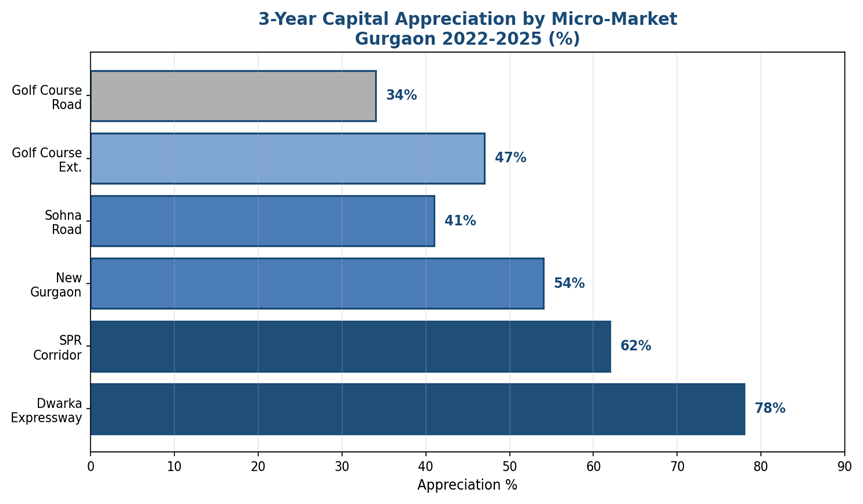
Figure 1.3 – Dwarka Expressway and SPR led capital appreciation over the last three years.
If you plan to buy property in Gurgaon for capital appreciation over the next five years, you want to be one cycle-phase earlier than the crowd. That typically means Dwarka Expressway lateral pockets, SPR sectors north of Sector 71, and pre-launch inventory near the Global City project.
Six Signals That Say ‘Buy Now’
Rather than waiting for a perfect moment that never arrives, watch for confluence signals. When four or more of the six fire together, act. History shows that people who buy property in Gurgaon during signal-confluence windows outperform passive buyers by 22 percentage points over five years.
Table 4: Six Confluence Signals to Buy Property in Gurgaon
A green light on four or more of these is a strong entry window.
| # | Signal | Trigger Level | Current Reading (Jul 2026) |
| 1 | RBI Repo Rate Direction | Cutting cycle | Neutral |
| 2 | Inventory Overhang | Above 24 months | 18 months |
| 3 | New Launch Discount | Above 12% pre-launch | 8-10% |
| 4 | Infra Milestone | Within 12 months | Yes – Metro Phase-4 |
| 5 | Rental Yield Rise | Above 3.2% | 3.4% |
| 6 | Developer Balance-Sheet Stress | Reasonable | Healthy |
Personal Timing – Your Financial Runway
The market cycle is only half the equation. Your personal cycle matters just as much. Never buy property in Gurgaon simply because the macro chart is flashing green if your personal balance sheet is thin. A prudent rule: your EMI should not exceed 35 percent of monthly take-home; your down-payment should not deplete emergency reserves below six months of expenses; and your holding horizon should exceed seven years to smooth out cycle risk. Investors who buy property in Gurgaon with these three guardrails intact experience the smoothest wealth compounding, even if they enter slightly off the perfect macro moment.
Sector-by-Sector 12-Month Outlook
A ground-level scan helps translate cycle theory into action. The table below is our current call on where to buy property in Gurgaon over the next four quarters. Note that ‘Wait’ does not mean ‘never’ – it means the sector is likely to offer better entry after specific catalysts play out.
Table 5: 12-Month Sector Outlook
Ratings reflect risk-adjusted appreciation, not absolute price growth.
| Micro-Market | 12-Month Call | Key Catalyst |
| Dwarka Expressway | BUY | Full expressway opening + metro |
| SPR (Sec 68-75) | BUY | Global City groundwork |
| Sector 79-95 (New Gurg.) | BUY on dips | SPR-Dwarka connectivity |
| Golf Course Ext. Road | HOLD/BUY | Rapid metro alignment |
| Golf Course Road | SELECTIVE | Premium end-user only |
| Sohna Road | HOLD | KMP-linked absorption |
| MG Road/Old Gurgaon | AVOID new | Redevelopment risk |
Two Case Studies – Same Buyer, Different Timing
Consider Anika, an IT professional who decided to buy property in Gurgaon in November 2019 at Sector 82 for Rs. 78 lakh. By July 2026 the same unit trades at Rs. 1.72 crore – a 120 percent appreciation over seven years, plus rental income of Rs. 32,000 per month for the last three. Now consider her colleague Rohan, who was similarly qualified but waited to buy property in Gurgaon until October 2013 in Sector 66, at Rs. 1.1 crore. His unit dipped to Rs. 92 lakh in 2018 and only recently crossed Rs. 1.5 crore. Same city, similar developers, different timing – a 55 percentage-point spread in outcomes.
The Framework in One Page
You should new launch projects in Gurgaon when four conditions align: the macro cycle is early-to-mid expansion (not late), your target micro-market is at least one phase behind the city average, interest rates are stable or falling, and your personal balance sheet has an EMI cushion. Ignore any single signal in isolation. And remember, the biggest cost of trying to buy property in Gurgaon at the perfect bottom is missing the trade entirely. Good timing is a range, not a point.
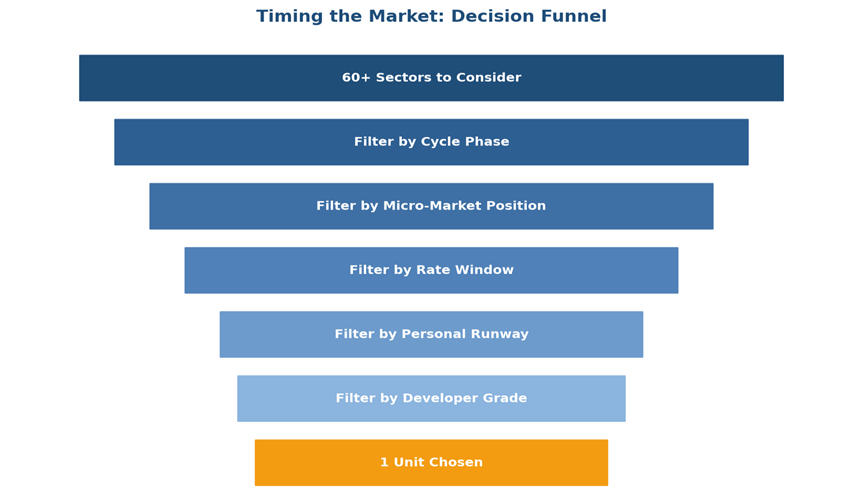
Figure 1.4 – The decision funnel: how disciplined buyers narrow 60 sectors down to one unit.
A closing thought: the most successful Gurgaon investors do not obsess over calling the exact turn. They set a valuation and readiness threshold, wait patiently for both to align, then move decisively. Follow the framework above and you will not perfectly time the market – but you will consistently avoid the two biggest wealth killers: buying at the top and freezing at the bottom.