

Why 2026 Is a Turning-Point Year for Gurgaon
Gurugram has stopped behaving like a speculative frontier and started behaving like an institutional market. In Q1 2026, Delhi–NCR clocked 30% year-on-year sales growth, and Gurgaon alone accounted for close to 73% of regional new launches (Anarock, Q1 2026 Residential Viewpoints). In the first four months of 2026, Gurugram RERA registered nearly ₹27,000 crore of fresh project best property investment in Gurgaon 2026. This is no longer a market of end-user speculation — it is a market of listed developers, global capital, RERA-regulated approvals, and buyers writing cheques in dollars as often as in rupees.Yet the growth is uneven. Oberoi Realty’s Three Sixty North on Sector 58 (Golf Course Extension) is priced at roughly ₹38,000 per sq ft for bare-shell 4 BHK and ₹43,000–45,000 psf for finished units — a benchmark that would have seemed unthinkable on this corridor even two years ago. Experion One42 on Golf Course Road opened at ₹44,705 psf, and a resale unit there has already traded above ₹1 lakh psf carpet. DLF Camellias — launched in 2015 at ~₹25,000 psf — now resells between ₹65,000 and ₹1 lakh+ psf (Opulnz Abode, Superluxere, 2026). Meanwhile, Cyber City office rentals cleared ₹132.5 psf/month in the recent Airbnb lease and touch ₹200 psf for the best Grade-A stock (Business Standard, 2026).Below are the trends actually shaping where money moves in Gurgaon through 2026 and beyond — with the tables, project-specific price benchmarks, diagrams, and answers that keep coming up in investor conversations.
The one-line thesis: 2026 rewards corridor selection over city selection. Getting the sub-market right in Gurgaon matters more than getting the state or city right in India.

The Demand Stack: Five Forces That Move Gurgaon Prices
Every Gurgaon property decision in 2026 rests on five stacked forces. Interest rates and job growth sit at the base — they determine whether cheques get written at all. Corridor infrastructure and buyer profile sit in the middle — they determine which corridor and which segment. Sector zoning and RERA compliance sit at the top — they determine whether a specific project is worth signing on.
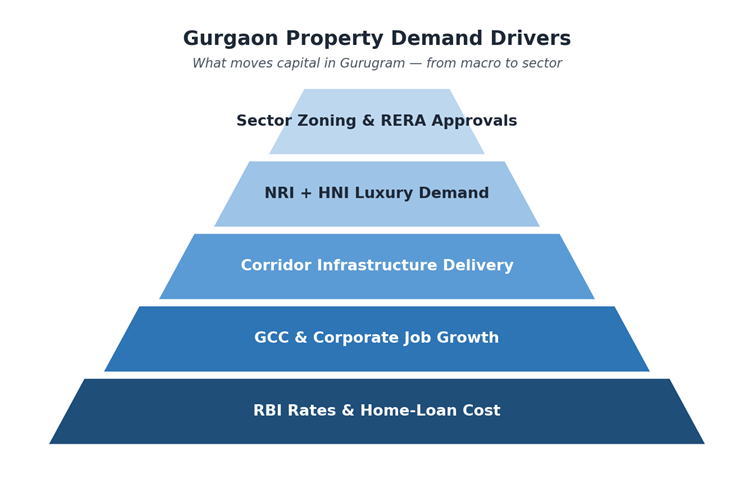
Figure 1. Gurgaon demand drivers stack from macro to sector. Investors who skip the base layers end up buying good units in bad cycles.
Trend 1: RBI Rate Cycle, Home-Loan Cost, and What They Actually Mean for You
The RBI’s easing cycle through 2025 pushed home-loan rates down toward the 8.2–8.6% range for prime borrowers by mid-2026, from a peak above 9%. That drop is significant but nowhere near the sub-7% environment of the last cycle. Higher EMI headroom is fuelling premium and mid-premium launches faster than affordable ones, which is exactly why Gurgaon — a market that skews premium — has outperformed Noida and Ghaziabad in launch momentum.
The practical read: model deals to an 8.5% home-loan rate and check that rentals cover at least a portion of the EMI. If the yield-versus-EMI gap only closes on the assumption of aggressive appreciation, the deal is trend-following rather than cash-flow investing — a distinction that mattered less in 2019 and matters a lot in 2026.
Practical takeaway: at 8.5% loan cost, a Gurgaon rental yielding 3.5% requires appreciation of at least 5% p.a. just to break even in real terms. Underwrite accordingly.
Trend 2: The Corridor Rotation — Where Money Is Actually Flowing
Investors who bought “Gurgaon” as an idea in 2019 saw very different outcomes depending on which corridor they picked. That dispersion is only widening in 2026. Golf Course Road (GCR) is now firmly ultra-luxury: Experion One42 launched at ₹44,705 psf, DLF Camellias resells between ₹65,000 and ₹1 lakh+ psf, and Trump Residences by Smartworld-Tribeca on Sector 69 starts at ₹9.27 crore. Golf Course Extension Road (GCER) is where the momentum benchmark has shifted — Oberoi Three Sixty North is priced at ₹38,000–45,000 psf (bare shell to finished), M3M Golf Estate on Sector 65 moved from ₹24,300 to ₹24,600 psf in Q1 2026, and industry consensus expects the corridor to test ₹1 lakh psf within the decade.
Dwarka Expressway has flipped from delayed-infra story to delivered corridor. Corridor-wide new-launch average sits near ₹17,250 psf, but the range is wide: M3M Altitude opens from ₹10,500 psf, Godrej Miraya at ₹11,000–12,500 psf, Sobha Altus from ₹13,500 psf, while premium sectors clear ₹18,000–25,000 psf and Signature Global Twin Tower DXP on Sector 84 re-rated from ₹13,700 to ₹21,000 psf in a single quarter (+53%). SPR gives buyers a controlled entry point: 99acres puts the corridor average around ₹13,000 psf, DLF Privana launched at ₹23,000 psf with average ticket ~₹9.5 crore, and Signature Global SPR Estate starts at ₹20,000 psf.
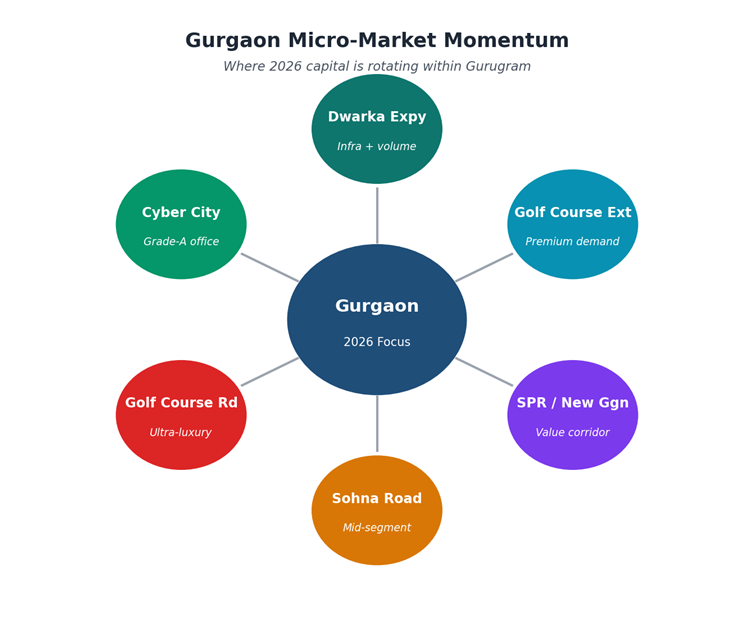
Figure 2. Where 2026 capital is rotating within Gurugram. Bubble color indicates momentum quality, not size.
The table below summarises how each major Gurgaon corridor is positioned entering the second half of 2026, with representative recent launches and portal-reported ranges.
| Corridor | Rate (₹/sq ft, 2026) | Representative Project | Investor Positioning |
| Golf Course Rd | 44,000–1,00,000+ | Experion One42; DLF Camellias (resale) | Trophy assets only |
| Golf Course Ext | 20,000–45,000 | Oberoi Three Sixty North; M3M Golf Estate | Core-plus / new launches |
| Dwarka Expressway | 10,500–25,000 | Sobha Altus; M3M Altitude; Godrej Miraya | Selective — completed towers |
| SPR / New Ggn | 13,000–23,000 | DLF Privana; Signature Global SPR Estate | Long-hold, rental play |
| Sohna Road | 12,450–20,000 | BPTP; multiple mid-premium launches | Affordable-plus segment |
| Cyber City / DLF3 | ₹110–200 psf/mo (lease) | DLF Cyber City; Airbnb lease @₹132.5 | Grade-A commercial only |
Sources: 99acres, Square Yards, Anarock Q1/Q2 2026, Opulnz Abode, Superluxere, Business Standard. Rates are indicative and vary by tower, floor, and view.
Trend 3: GCCs Have Quietly Become the Biggest Force in the Market
Global Capability Centres now account for roughly 40–45% of enterprise office-seat uptake in Gurgaon, with projections of 50%+ within two years (CBRE, TrueAsset). Flex-workspace operators add another 20–25% of India-wide leasing, and Gurgaon leads that pack. The reference lease of the year — Airbnb’s 46,000 sq ft GCC in DLF Cyber City at ₹132.5 psf/month, commenced October 2025 — is a live data point that top-quality Cyber City rentals remain firmly above the ₹130 psf mark, with premium buildings clearing ₹200 psf/month. Vacancy in Grade-A Cyber City stock remains below 10% because GCC and flex demand keeps absorbing new supply.
For residential investors, this is the single most durable tailwind in the Gurgaon story. A GCC-driven tenant is typically a 24–30 month lease, a 1.5–2 month advance, and a rent-hike acceptance of 6–8% at renewal. Every 1,000 GCC seats absorbed translates into rental demand for roughly 400–500 residential units within a 30-minute commute — which is the mechanism by which Cyber City’s office boom underwrites GCER, SPR, and DLF Phase 5 residential rentals.
Trend 4: The Affordability Squeeze — And the Rental Tailwind It Creates
End-user affordability in prime Gurgaon has structurally worsened. A modest 1,600 sq ft flat on GCER at ₹22,000 psf already clears ₹3.5 crore before registration, stamp duty, and GST — and premium GCER stock priced at Oberoi Three Sixty North rates (₹38,000–45,000 psf) starts at ₹21 crore ticket. Median household finance cannot support these tickets, which means the buyer pool for premium Gurgaon is increasingly HNIs, NRIs, and second-home buyers rather than salaried first-time owners. First-time owners are being pushed to Sohna Road (avg ₹16,300 psf, per 99acres) and southern SPR sectors like Sector 70A (BPTP Astaire Gardens at ~₹14–15k psf).
For rental owners, this bifurcation is a durable tailwind. Current residential yields across NCR sit at 2.5–4.5% (Sobha Realty rental yield report, 2026), with prime Gurgaon corridors at the upper end and select branded luxury projects clearing 5%. The would-be buyer priced out of GCER doesn’t leave the city — she rents there instead, and Gurgaon’s premium rental base grows structurally.
If you own well-located, well-managed rental product in Gurgaon, the next 24 months look like a re-rating window on both rent and capital value.
Trend 5: Infrastructure Delivery Is Finally Front-Loaded
For a decade, Gurgaon’s infrastructure story was “promised, not delivered.” That changed with the Dwarka Expressway opening, the ongoing SPR upgrades, and the Delhi–Mumbai Expressway link near Sohna. The re-rating is measurable: Dwarka Expressway property values are up roughly 3.5x in five years, with a Signature Global Twin Tower DXP unit on Sector 84 re-rating from ₹13,700 to ₹21,000 psf in Q2 2026 alone (+53% quarter). Metro extensions to Cyber City and along the Old Gurgaon–Sector 22 corridor are progressing on visible timelines.
The pattern in every mature real-estate market is the same: infrastructure delivery compresses time-to-yield. A corridor that took ten years to appreciate before delivery often gains another 25–40% in the two years after delivery, then plateaus. Investors buying corridors like Dwarka Expressway in 2026 are buying into the plateau-formation window, not the discovery window. The trade is real but requires selectivity — completed inventory from tier-1 developers like Sobha, DLF, Godrej, and M3M, not off-plan bets on the last mile.
Trend 6: NRI and HNI Money Has Changed the Buyer Profile
Gurgaon’s premium segment is now visibly NRI-led. Repatriation-friendly FEMA rules, weakening rupee tailwind for USD/GBP earners, and the maturing of top-tier developers with global-benchmark specifications have combined to make premium Gurgaon a preferred non-resident investment. Branded-residence launches like Trump Residences by Smartworld-Tribeca on Sector 69 (starting ₹9.27 crore) and Oberoi Three Sixty North on Sector 58 have reportedly seen strong NRI allocations in early rounds, and DLF’s Privana launch on the Golf Course Ext / SPR interchange closed 1,164 units at an average ticket of ₹9.5 crore — a scale of large-ticket absorption that domestic HNI demand alone would struggle to explain.
This changes what “demand” looks like. NRI buyers are less rate-sensitive, more brand-sensitive, more specification-sensitive, and more comfortable with 3–5 year hold horizons. They do not panic-sell on a bad quarter. Which means the premium end of the Gurgaon market has become structurally less volatile than it was five years ago — but also less accessible for domestic buyers underwriting on rental yield alone.
An Investor Decision Framework for Gurgaon 2026
The trends above collapse into a repeatable five-step decision funnel. Every Gurgaon deal should pass through it in the same order, because a failure at an earlier stage cannot be recovered by success at a later one.
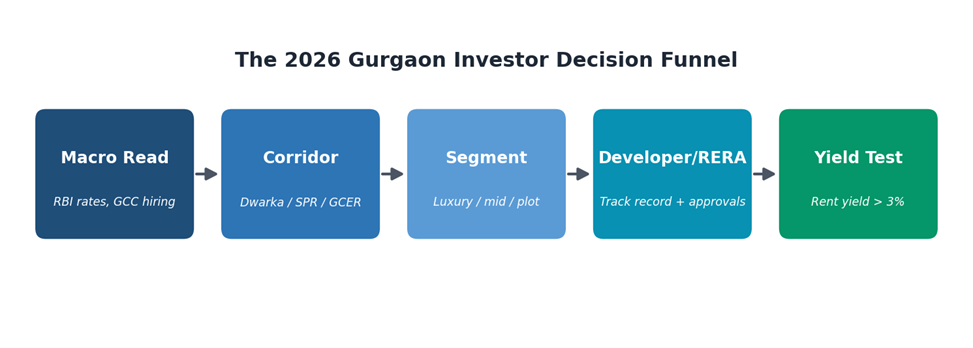
Figure 3. The 2026 Gurgaon investor decision funnel.
| Step | Question | Green Light | Red Flag |
| 1. Macro read | Rates & GCC hiring supportive? | RBI easing; GCC leases signing | Rate reversal; hiring freeze |
| 2. Corridor | Which sub-market are we in? | Delivered infra + tier-1 developer | Off-plan on unfunded corridor |
| 3. Segment | Luxury / mid / plot? | Buyer profile matches segment | Premium unit on weak-demand corridor |
| 4. Developer / RERA | Approvals clean, track record strong? | RERA-registered, delivery history | Litigation history; occupancy delays |
| 5. Yield test | Does it produce ≥3% rental yield? | Yield covers meaningful EMI | Bet depends entirely on appreciation |
Frequently Asked Questions
Is Gurgaon still a good long-term investment in 2026?
Yes — but selectively. As a whole city, Gurgaon has moved from speculative growth to structured, institutional growth. Overall price appreciation of 8–15% p.a. is a reasonable base case for 2026, but that figure hides significant dispersion between corridors. Golf Course Road, Golf Course Extension, and delivered Dwarka Expressway are the clearest “yes.” Fringe sectors without confirmed infrastructure timelines remain speculative.
Dwarka Expressway or Golf Course Extension — which corridor should I pick?
Depends on horizon and ticket size. Dwarka Expressway offers better entry pricing — from ₹10,500 psf on M3M Altitude and ₹13,500 psf on Sobha Altus, up to ₹21,000 psf on Signature Global Twin Tower DXP — and clear post-infra re-rating potential, best suited for a 5–7 year hold. GCER is meaningfully more expensive: M3M Golf Estate at ₹24,600 psf, Oberoi Three Sixty North at ₹38,000–45,000 psf, with stronger current rental yield and faster resale liquidity. If cash flow matters, GCER. If capital growth over a longer horizon matters, Dwarka Expressway with a tier-1 completed project.
What rental yield can I actually expect in Gurgaon?
Base case is 2.5–3.5% gross across the city. Well-positioned units in GCER, SPR, and Sohna Road can clear 4–4.5%. Select branded luxury projects with strong operator programmes have delivered 5–8%, but those are outliers with concentration risk. Underwriting a Gurgaon deal at a 5%+ yield is not conservative — 3% to 3.5% is.
How does the GCC boom actually affect me as a residential investor?
It stabilises demand. Every large GCC lease signed in Cyber City or DLF Phase 3 translates into a durable pool of high-quality residential tenants within a 30-minute drive. GCC-driven tenants sign longer leases, accept larger rent hikes at renewal, and are less prone to breakage than typical Indian residential tenants. If your unit is within reach of a growing GCC hub, your vacancy risk is materially lower.
Are NRI-heavy launches a good sign or a red flag?
Neither, by itself. NRI-heavy launches signal strong developer branding and typically better specifications, which support long-term value. The caution is on liquidity: heavy NRI allocation can mean thinner secondary resale volumes and slower price discovery on the way down. If you plan to hold 5+ years, that is not a problem. If you plan to flip within 24 months, prefer projects with a healthier domestic-buyer mix.
Should I buy under-construction or ready-to-move-in?
In 2026, the ready-to-move premium has compressed from what it was two years ago because RERA compliance has improved delivery certainty. Under-construction from a tier-1 RERA-registered developer with a strong delivery track record is a defensible bet. Under-construction from an unknown or litigated developer, at any discount, is not. Ready-to-move remains the right answer for anyone underwriting on rental yield rather than pure appreciation.
Bottom Line for 2026
Gurgaon in 2026 rewards discipline over enthusiasm. The macro tailwind — RBI easing, GCC absorption, delivered infrastructure, NRI capital — is real. The dispersion between the best and worst outcomes is wider than it has been in a decade. Investors looking for the best property investment in Gurgaon 2026 should anchor on a specific corridor, a tier-1 developer, RERA-clean approvals, and a defensible rental yield. Neem Infra helps investors identify such opportunities, while investors chasing the last cycle’s trends — off-plan bets on undelivered corridors, aggressive leverage assuming rates fall further, appreciation-only underwriting — will not.
The trends discussed here are structural, not cyclical. Gurgaon’s transformation into an institutional market will shape returns not just through 2026 but through the balance of the decade. Pick the corridor, pick the developer, insist on cash flow, and let the framework do the filtering with Neem Infra for the best property investment in Gurgaon 2026.
Data Sources
Pricing and market-data references drawn from: Anarock Q1/Q2 2026 Residential Market Viewpoints; Knight Frank India Real Estate H1 2026; CBRE India Office Market updates; 99acres micro-market rate pages; Square Yards project databases; developer public disclosures (Oberoi Realty, DLF, M3M, Sobha, Godrej, Signature Global, Experion, Smartworld-Tribeca, BPTP); Opulnz Abode and Superluxere research notes; Business Standard lease reporting. All rates are indicative — actual transacted prices vary by tower, floor, view, unit configuration, and finish level. Verify with a RERA-registered broker before committing.